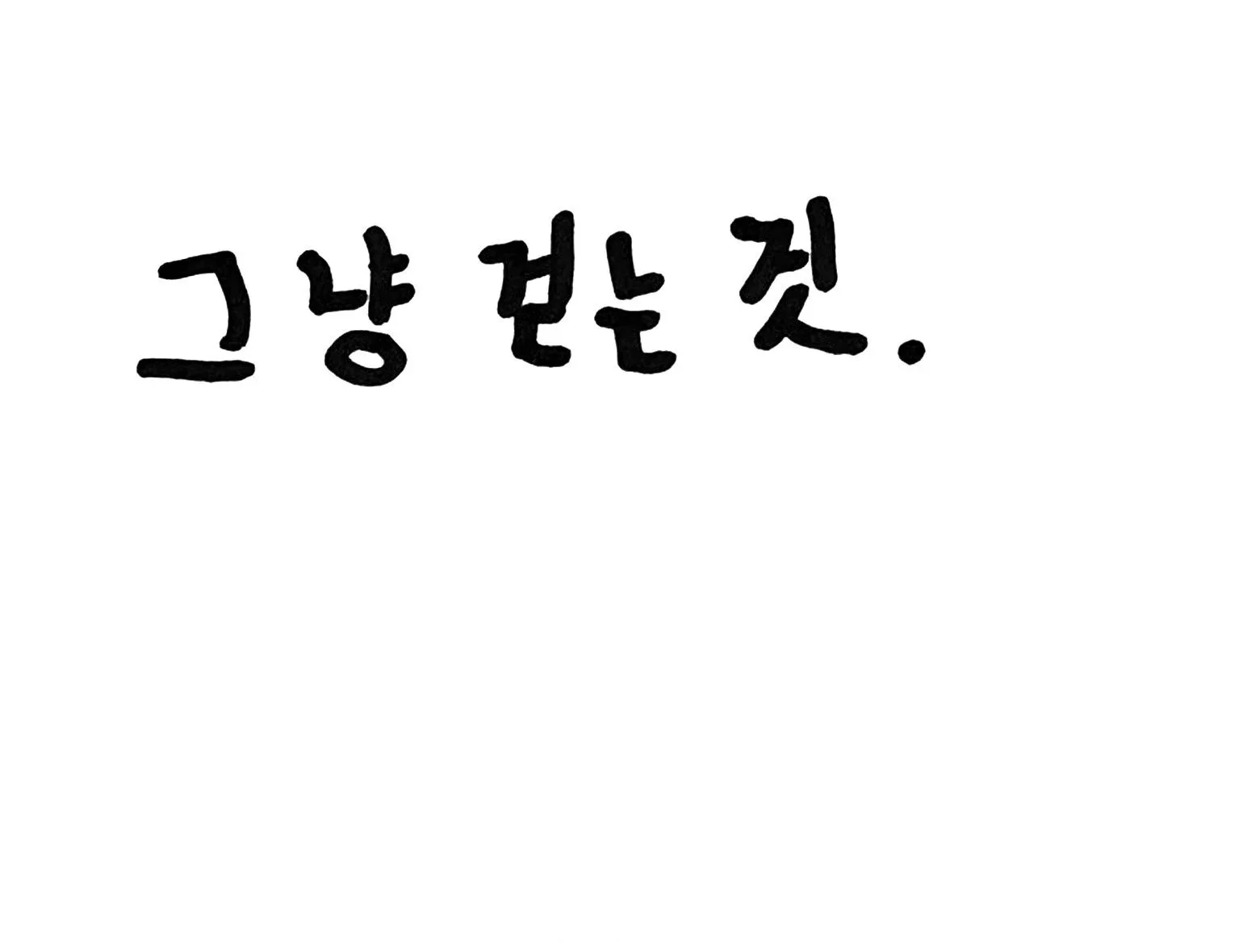
라움콘 《다시 걷는 노-하우》 2019, 텍스트, Pen on paper

laumkon 《Know-How of RE-walk》 2019, Text, Pen on paper, Varible size.
송지은 : 넘어짐이 불안한 이유가 넘어질 때 오른쪽 편에 힘이 없잖아. 힘이 없는 오른쪽으로 몸이 휙 넘어가. 오른쪽이 연약한데 오른쪽으로 넘어지니까 다칠 것 같아서 불안한 거야. 왜냐하면 오른쪽을 스스로로 방어할 수가 없으니까.
송지은 : 우리가 걷는 바닥의 질감이 다 다르잖아. 그러니까 아스팔트, 시멘트 벽돌길, 흙바닥 다르잖아. 그 질감에 따라서 불안도가 더 강해지는 것 같아. 또 그 질감 때문에 발목의 방향이 움직이는게 보여. 그런 시각적인 것 때문에 나의 왼쪽 몸은 항상 긴장이 돼 있는 거야. Q레이터가 넘어지는 방향에 대비해서 나의 왼쪽은 항상 긴장돼 있어. 나는 마비가 없지만. 그대는 어때? 항상 내가 함께 해줄 수 있는 상황이 아니다 보니까 때로는 이런 허허벌판의 장소, 도시 공간을 걷는다는 게 나는 때로는 불안한 시간들인 것 같아. 이런 울퉁불퉁함, 내리막길이나 각도가 다른 장소를 걸어 다닐 때 넘어질 수 있잖아.
Jee Song : Falling makes you anxious because your right side is weak. when you suddenly topple onto it, it feels like you might get hurt, as it cannot protect itself.
Jee Song : The textures of the ground we walk on are all different. Asphalt, concrete, brick paths, dirt paths—they are all different. Depending on that texture, your level of anxiety seems to grow stronger, and because of that texture I can really feel how the direction of your ankle keeps shifting. Since I can see that, my left side of the body is always tense because of that visual—because of that visual sensation. My left side is always tense in preparation for the moment you might fall, falling toward the weak right side. Even though I am not paralyzed. How is it for you? I cannot always be there to do that for you, walking through these kinds of wide‑open places, through urban space, sometimes feels to me like stretches of time filled with indistinct anxiety. When we walk on these bumpy surfaces, or on slight slopes, or places where the angle is a bit different, you could fall.
Q레이터 : 자 여기서 걷는다. 걷다가 걷다가
Q레이터 : 오른쪽 다리 힘들다. 오른쪽 다리가 버틴다. (잠시 멈춰섰다) 뒤에서 오른쪽 다리 좀 봐봐.
송지은 : 버틴다, 버틴다
Q레이터 : 됐어 (오른쪽 다리를 내딛는다) 간다.
Q레이터 : 간다 그리고 간다, 간다...한 걸음 두 걸음
Q레이터 : 세 걸음 네 걸음
Q레이터 : 다섯 걸음??? 아니 이게 몇 걸름이지....네 걸음이었어... 네 걸음
Q레이터 : 다섯 걸음 .... 일곱 걸음 여덟 걸음
Q레이터 : 난 두려워
송지은 : 불안해?
Q레이터 : 어 불안해라
송지은 : 어떤 게 불안해?
Q레이터 : (다시 걷기 시작한다) 한 걸음 두 걸음 세 걸음 네 걸음
Q레이터 : 확실히 불안해
송지은 : 넘어지는 거 불안하다는 거야?
Q레이터 : 오른쪽 다리... 이쪽에 (왼쪽에) 멀쩡한 다리가 있고.
송지은 : 처음에 Q레이터는 ‘넘어지는거 아무렇지도 않아' 라고 했지.
Q레이터 : 오른쪽 다리를 천천히...오른쪽 왼쪽 오른쪽 왼쪽 계속 이렇게 번갈아 가는데
Q레이터 : 글쎄요. 뭘까?
송지은 : 넘어지기 해보니까 어떤 게 더 느껴졌어?
Q레이터 : 더 움직이기 싫어. 움직이기가 싫어서...넘어져서 다칠까 봐...이렇게 된 몸이 넘어지기게 낮설어.
Qrator : So, here we walk. Walking and walking.
Qrator : The right leg is strained. The right leg is holding me up. (Come to a brief stop) Look at my right leg from behind.
Jee Song : It’s holding, holding.
Qrator : That’s it. (Steps forward with the right leg.) I’m going.
Qrator : Going, and going, going… One step, two steps.
Qrator : Three steps, four steps.
Qrator : Five steps??? No, how many steps was that… It was four steps… four steps
Qrator : Five steps… seven steps, eight steps
Qrator : I’m afraid.
Jee Song : You feel anxious?
Qrator : Yeah, I feel anxious.
Jee Song : What makes you anxious?
Qrator : (Starts walking again.) One step, two steps, three steps, four steps
Qrator : I definitely feel anxious.
Jee Song : Are you saying you’re anxious about falling?
Qrator : The right leg… On this side (on the left side) there is the leg that’s fine.
Jee Song : At first, you said, “I don’t mind falling at all.”
Qrator : To walk straight, I have to move my right leg slowly… Right, left, right, left, keeping on alternating like this.
Qrator : Well… what is that?
Jee Song : After falling, what did you feel more strongly?
Qrator: I don’t want to move any more. I don’t want to move… I’m afraid I’ll get hurt by falling… This body that can fall like this feels unfamiliar.
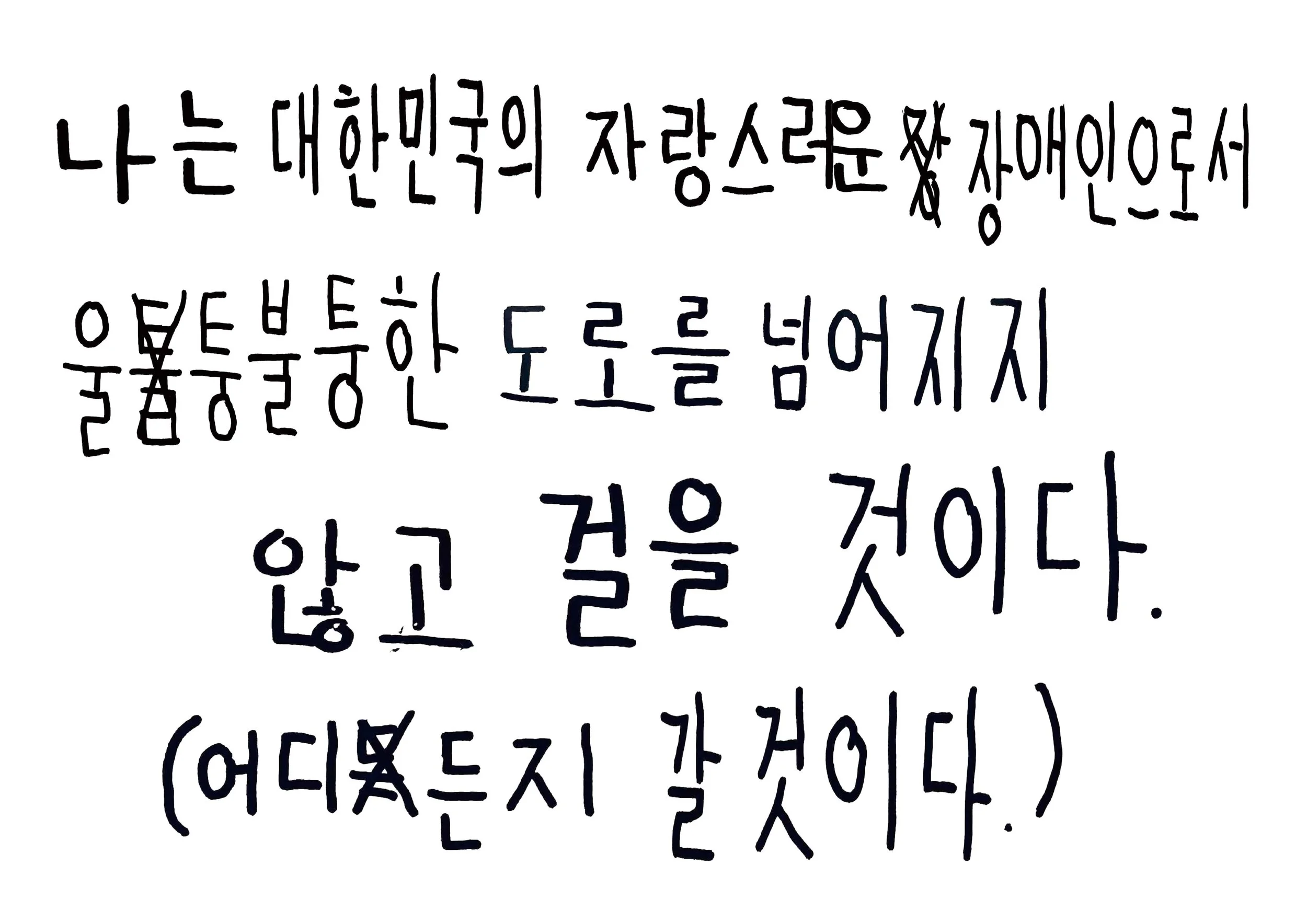
라움콘 《다시 걷는 노-하우》 2024, 텍스트, Pen on paper

laumkon 《Know-How of RE-walk》 2024, Text, Pen on paper, Varible size.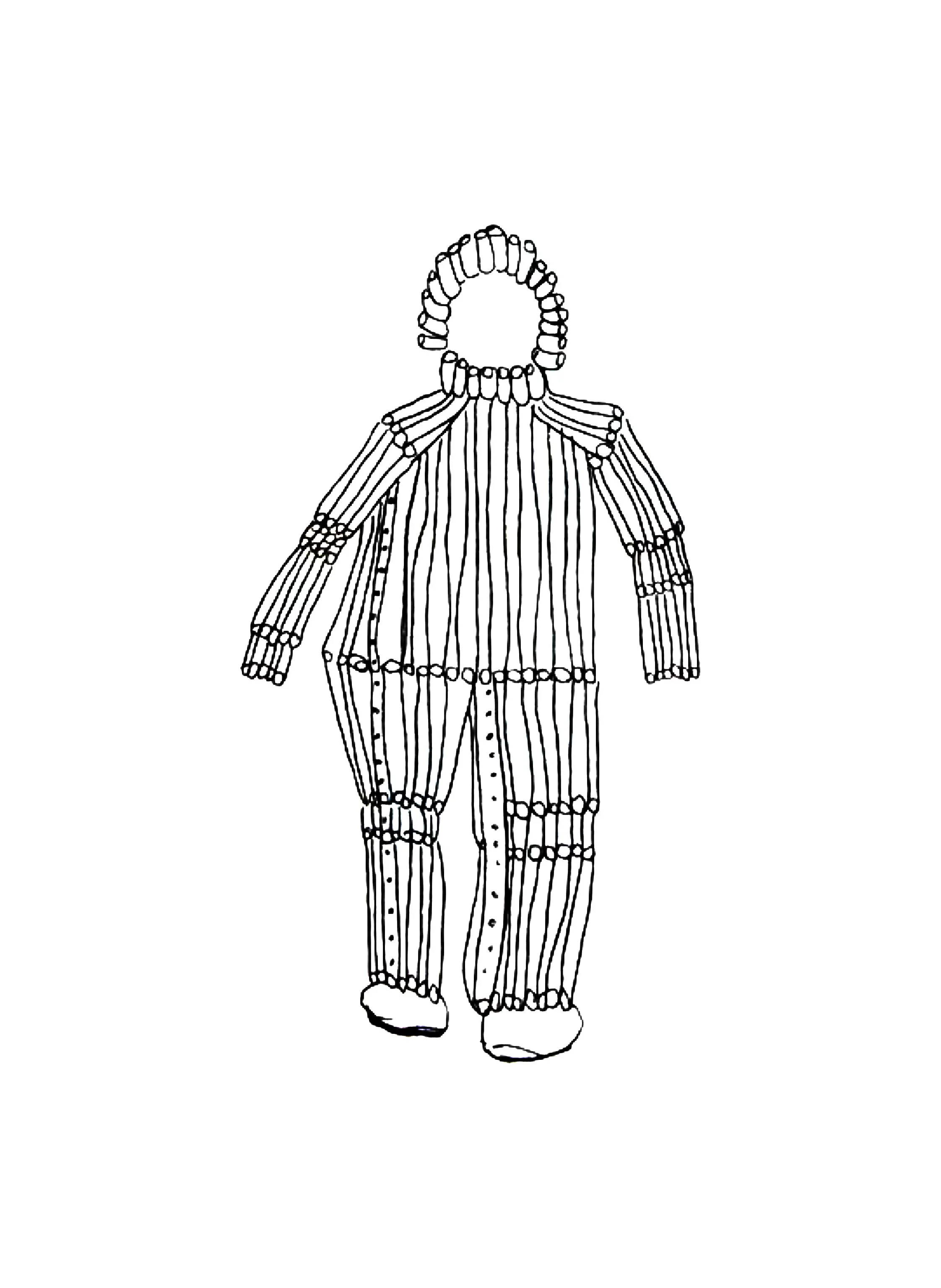
라움콘 《MOVE BY 라움콘》 2019, 드로잉, Pen on paperlaumkon 《MOVE BY laumkon》 2019, Drawing, Pen on paper, Varible size.PVC 비닐은 폴리염화비닐 Polyvinyl Chloride 이라는 고분자 플라스틱을 얇게 가공한 재질이다. 일상에서 흔하게 보는 이 재료는 탄소와 탄소가 사슬로 연결되었고, 그 사슬에 염소(Cl) 가 가지처럼 하나씩 달려 있는 화학 구조를 가지고 있다. 가볍지 않고 빛과 열에 약하지만, 공기와 기름에는 잘 버티며 염소(CI) 덕분에 난연성의 특징도 띈다.
PVC 자체는 상당히 단단한데, ‘비닐’이라고 느끼는 특유의 말랑함은 가소제 Plasticizer 를 얼마나 사용하는가에 따라 달라진다. 가소제가 적으면 딱딱한 배관이 되고, 많이 넣으면 투명하고 부드러운 시트가 된다. 따라서 PVC의 촉감은 가소제 비율에 따라 바뀐다. 부드러운 PVC 비닐은 손에 닿았을 때 약간의 끈적임, 정확히 말하면 표면 마찰감이 있고, 유연하게 구부러지며 미세한 고무 느낌이 남는다. 반대로 가소제 비율이 낮은 PVC는 차갑고 딱딱하며, ‘톡’ 하고 두드리면 유리처럼 가볍게 울린다.
일상에서 PVC 비닐은 투명 커버, 파일, 우비, 카드 홀더, 인테리어 시트지, 전선 피복, 욕실 매트, 바닥 장판, 의료용 혈액백, 방수 포장재, PVC 파이프 등에 사용되는데 유연한 PVC는 생활용품, 가구 커버, 포장재에 쓰이고, 단단한 PVC는 건축자재나 배관에 사용된다.
PVC가 공기주입 가능하게 제작하면 얇고 늘어져 있는 비닐이 부풀어 오르며 구조체가 된다. 얇은 막이 공기를 품으며 단단해지고, PVC가 가진 특유의 매끈하면서도 약간 끈적이는 질감이 공기층 위로 확장되어 부드러움과 딱딱함이 동시에 존재하게 된다.
하지만 이 재료는 열이나 자외선에 오래 노출되면 염소가 떨어져 나가며 누렇게 변하고, 가소제가 조금씩 빠져나며 딱딱해지거나 표면이 눅눅해진다.
PVC vinyl is a thinly processed material made from the polymer plastic polyvinyl chloride (PVC), in which carbon atoms are linked in chains with individual chlorine (Cl) atoms attached like branches along that chain. In everyday life, this familiar material is not especially light and is vulnerable to light and heat, yet it resists air and oil well and, thanks to its chlorine content, possesses flame-retardant properties.
PVC itself is quite rigid; the characteristic softness that makes it feel like “vinyl” depends on how much plasticizer is used. With little plasticizer, it becomes hard piping, whereas with a higher plasticizer content, it becomes a transparent, flexible sheet, so the tactile quality of PVC varies according to the plasticizer ratio. Soft PVC vinyl feels slightly tacky—more precisely, it has a surface friction when touched—bends flexibly, and leaves a faintly rubbery sensation, while PVC with a low plasticizer ratio is cold and hard, and when tapped gives off a light, glass‑like ring.
In daily life, PVC vinyl is used for transparent covers, document files, raincoats, card holders, interior sheets, cable insulation, bath mats, floor coverings, medical blood bags, waterproof packaging, and PVC pipes; flexible PVC is used for household goods, furniture covers, and packaging materials, whereas rigid PVC is used for construction materials and piping.
When PVC is manufactured so that air can be injected, a thin, drooping sheet swells and becomes a structural body: the thin film, once filled with air, stiffens, and PVC’s distinctive smooth yet slightly sticky texture expands over the air layer, allowing softness and hardness to coexist.
However, when this material is exposed to heat or ultraviolet light for extended periods, chlorine atoms detach, causing it to yellow, and the plasticizer gradually leaches out, making the material either stiffen or its surface turn clammy.
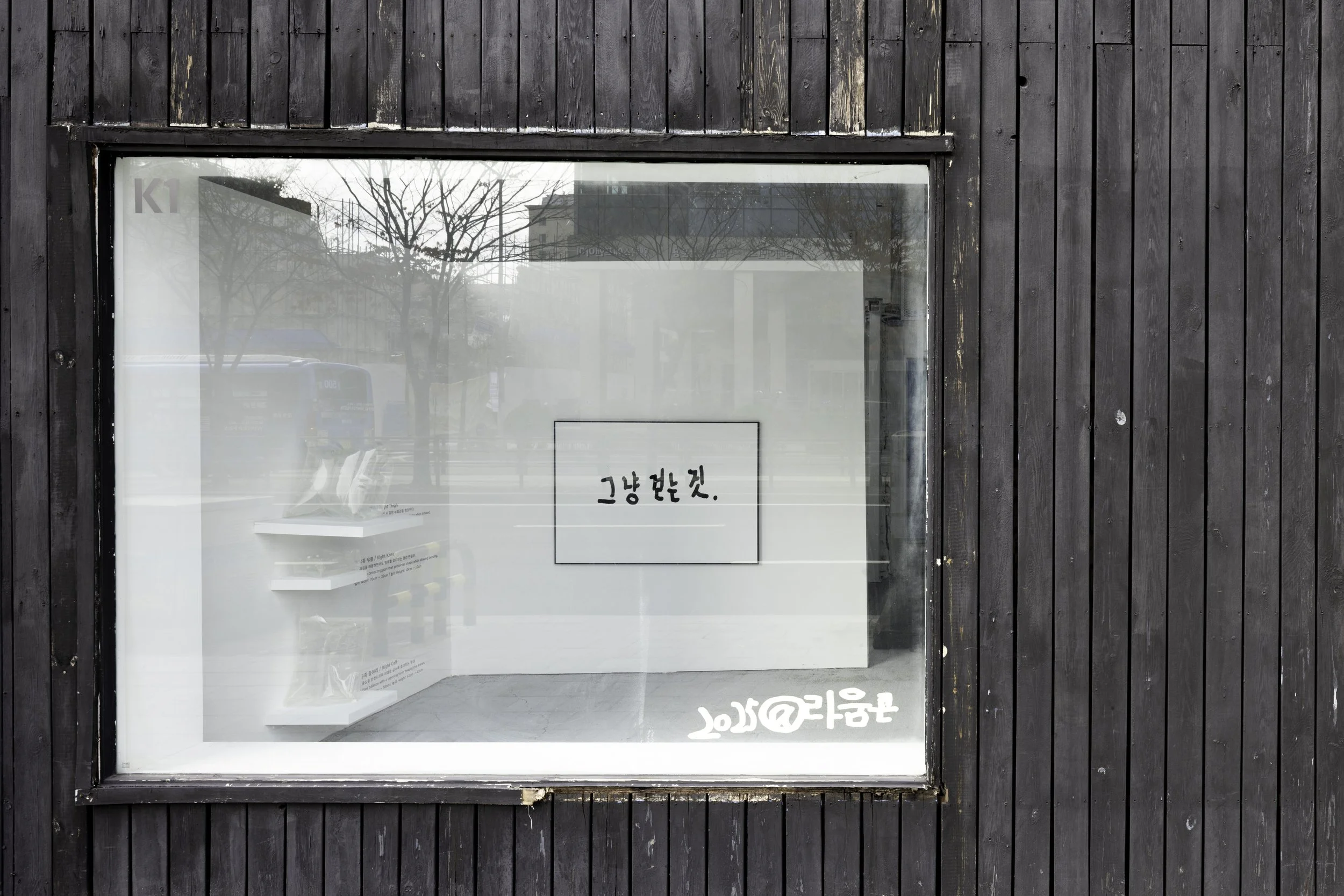
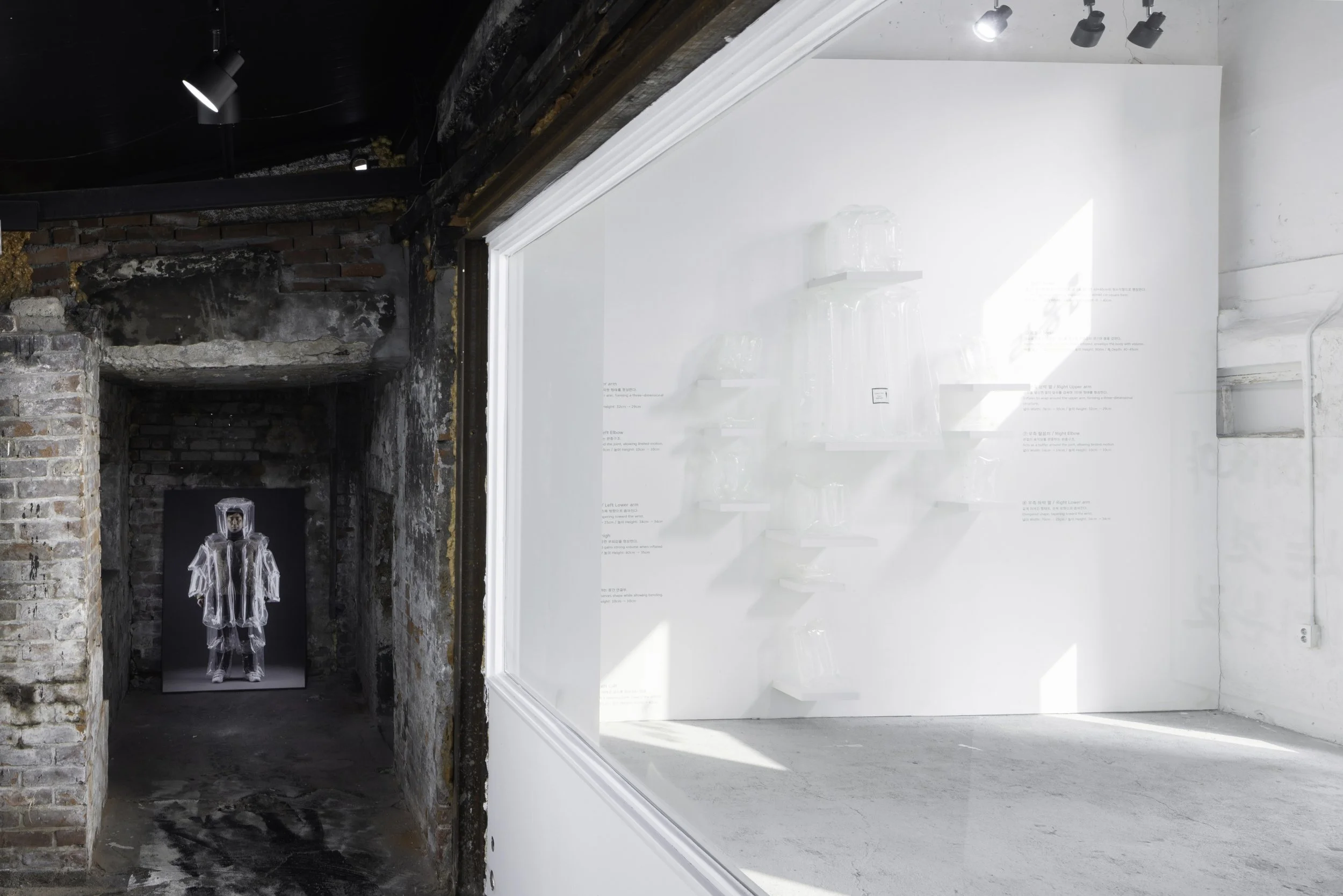
라움콘 《다시 걷는 노-하우》 2025, 전시 전경

laumkon 《Know-How of RE-walk》 2025, Installation view
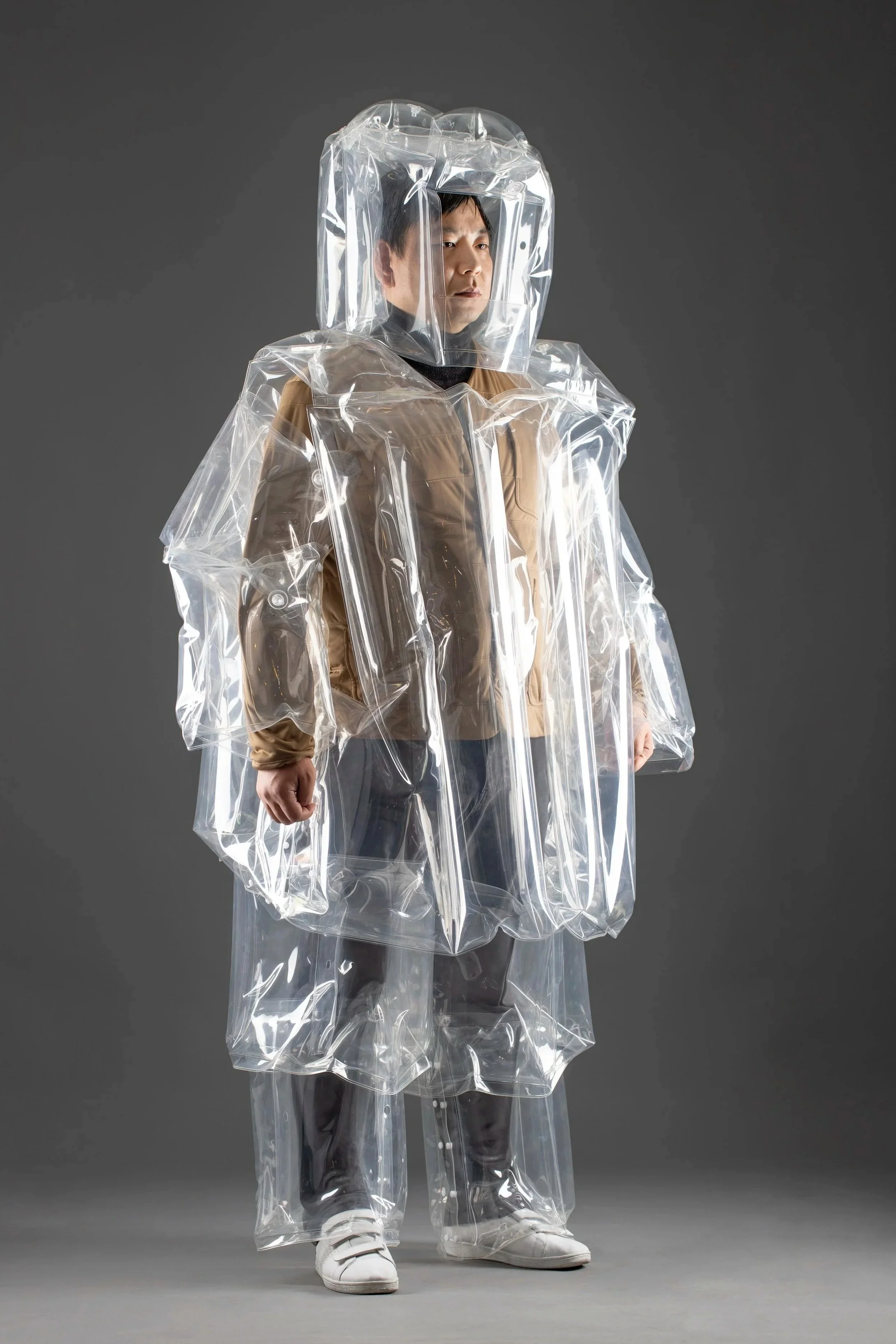

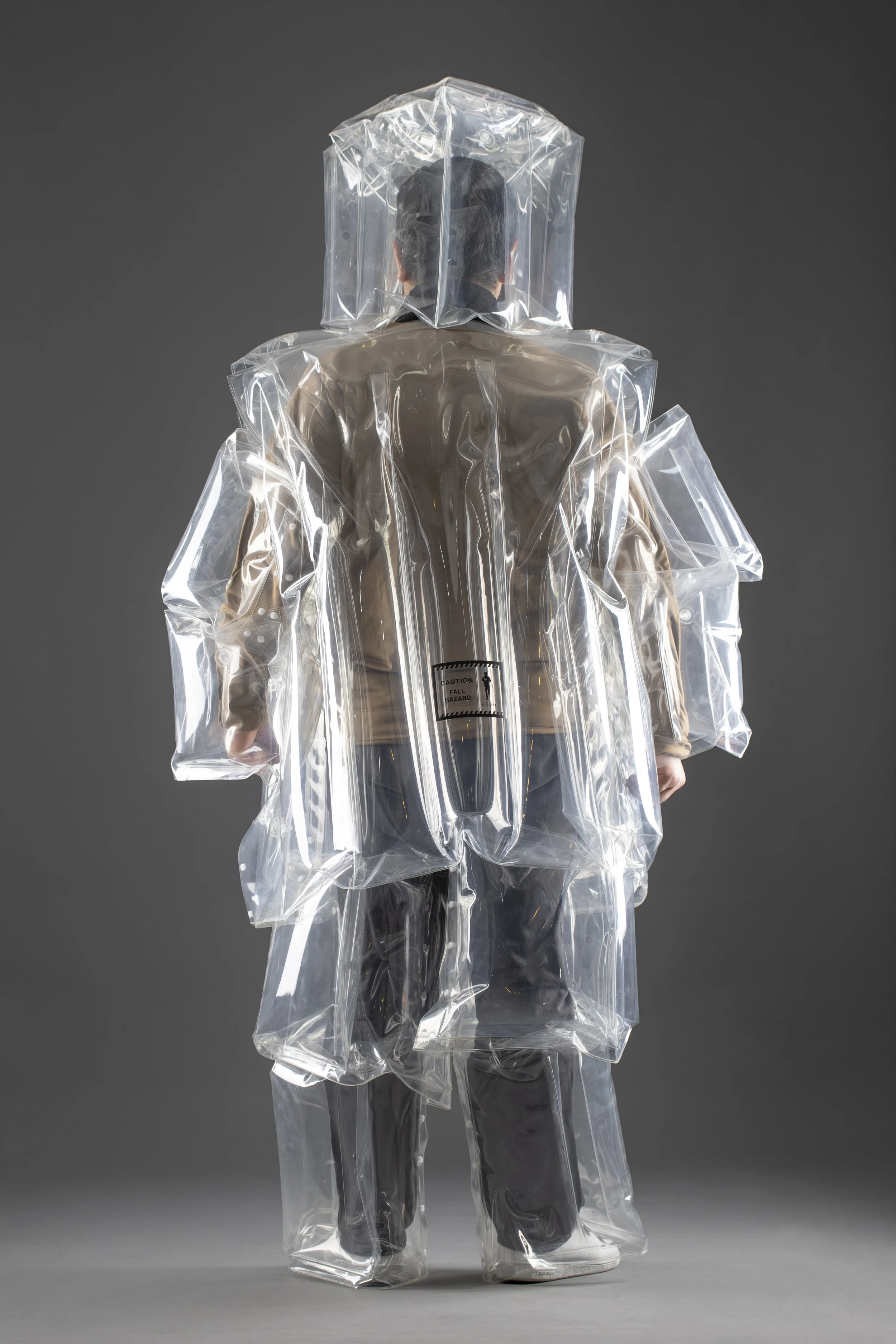
라움콘 《MOVE BY 라움콘》 2019, PVC 비닐, 흰색 스냅 단추, 검정 실크 프린팅 laumkon 《MOVE BY laumkon》 2019, PVC, White snap, Black silk print① 머리
평상시 납작한 형태로 보관되며, 공기를 넣으면 40×40cm의 정사각형으로 팽창한다.
바람 넣고 → 넓이 : 40cm / 높이 : 0 → 40cm
② 몸통
중심을 이루는 구조로, 공기를 넣으면 부피감이 생기며 몸을 감싼다.
바람 넣고 → 넓이 : 60cm / 높이 : 80cm / 폭 : 40–45cm
③ 좌측 상박 팔
공기를 넣으면 팔의 앞뒤를 감싸며 3차원 형태를 형성한다. 바람 넣고 → 넓이 : 74cm → 30cm / 높이 : 32cm → 29cm
④ 좌측 팔꿈치
관절의 움직임을 완충하는 완충구조다.
바람 넣고 → 넓이 : 54cm → 19cm / 높이 : 10cm → 10cm
⑤ 좌측 하박 팔
길게 이어진 형태로, 손목 방향으로 좁아진다.
바람 넣고 → 넓이 : 70cm → 25cm / 높이 : 34cm → 34cm
⑥ 우측 상박 팔
공기를 넣으면 팔의 앞뒤를 감싸며 3차원 형태를 형성한다.
바람 넣고 → 넓이 : 74cm → 30cm / 높이 : 32cm → 29cm
⑦ 우측 팔꿈치
관절의 움직임을 완충하는 완충구조다.
바람 넣고 → 넓이 : 54cm → 19cm / 높이 : 10cm → 10cm
⑧ 우측 하박 팔
길게 이어진 형태로, 손목 방향으로 좁아진다.
바람 넣고 → 넓이 : 70cm → 25cm / 높이 : 34cm → 34cm
⑨ 좌측 허벅지
신체 하부를 지탱하며 팽창 시 강한 부피감을 형성한다.
바람 넣고 → 넓이 : 103cm → 40cm / 높이 : 40cm → 35cm
⑩ 좌측 무릎
구부러짐을 허용하면서도 형태를 유지하는 중간 연결부다.
바람 넣고 → 넓이 : 70cm → 22cm / 높이 : 10cm → 10cm
⑪ 좌측 종아리
무게 중심을 안정시키며 아래로 갈수록 좁아지는 형태다.
넓이 : 78cm → 30cm / 높이 : 42cm → 42cm
⑫ 우측 허벅지
신체 하부를 지탱하며 팽창 시 강한 부피감을 형성한다.
넓이 : 103cm → 40cm / 높이 : 40cm → 35cm
⑬ 우측 무릎
구부러짐을 허용하면서도 형태를 유지하는 중간 연결부다.
바람 넣고 → 넓이 : 70cm → 22cm / 높이 : 10cm → 10cm
⑭ 우측 종아리
무게 중심을 안정시키며 아래로 갈수록 좁아지는 형태다.
바람 넣고 → 넓이 : 78cm → 30cm / 높이 : 42cm → 42cm
① Head
Stored flat; when inflated, it expands into a 40 × 40 cm square. Fill with air → Width: 40cm / Height: 0 → 40cm
② Torso
Forms the central structure; when inflated, it gains volume and envelops the body.
Fill with air → Width: 60cm / Height: 80cm / Depth: 40–45cm
③ Left Upper arm
Inflates to wrap around the upper arm on both sides, forming a three-dimensional structure. Fill with air → Width: 74cm → 30cm / Height: 32cm → 29cm
④ Left Elbow
Acts as a buffer around the joint, allowing limited motion.
Fill with air → Width: 54cm → 19cm / Height: 10cm → 10cm
⑤ Left Lower arm
Elongated shape, tapering toward the wrist.
Fill with air → Width: 70cm → 25cm / Height: 34cm → 34cm
⑥ Right Upper arm
Inflates to wrap around the upper arm on both sides, forming a three-dimensional structure. Fill with air → Width: 74cm → 30cm / Height: 32cm → 29cm
⑦ Right Elbow
Acts as a buffer around the joint, allowing limited motion.
Fill with air → Width: 54cm → 19cm / Height: 10cm → 10cm
⑧ Right Lower arm
Elongated shape, tapering toward the wrist.
Fill with air → Width: 70cm → 25cm / Height: 34cm → 34cm
⑨ Left Thigh
Supports the lower body and gains strong volume when inflated.
Fill with air → Width: 103cm → 40cm / Height: 40cm → 35cm
⑩ Left Knee
A flexible connecting part that preserves shape while allowing bending.
Fill with air → Width: 70cm → 22cm / Height: 10cm → 10cm
⑪ Left Calf
Stabilizes balance with a tapering form toward the ankles.
Fill with air → Width: 78cm → 30cm / Height: 42cm → 42cm
⑫ Right Thigh
Supports the lower body and gains strong volume when inflated.
Fill with air → Width: 103cm → 40cm / Height: 40cm → 35cm
⑬ Right Knee
A flexible connecting part that preserves shape while allowing bending.
Fill with air → Width: 70cm → 22cm / Height: 10cm → 10cm
⑭ Right Calf
Stabilizes balance with a tapering form toward the ankles.
Fill with air → Width: 78cm → 30cm / Height: 42cm → 42cm
라움콘 《MOVE BY 라움콘》 2019, 5분 21초

laumkon 《MOVE BY laumkon》 2019, 5mins 21sec
라움콘 《MOVE BY 라움콘》 2025, 5분
laumkon 《MOVE BY laumkon》 2025, 5mins누구나 삶은 변화할 수 있고. 그 방향은 자신이 의도하지 않은 특수한 형태일 수 있다
Anyone’s life can change, and that change may take a form they never intended.
그래서 존재한다는 것은 그 자체로 의미가 있는 것이지, 불편한 상태가 존재의 의미를 하락시키는 것은 아니다.
existence itself has meaning—an uncomfortable condition does not diminish its value.
재활 치료를 받으면 어디든지 자유롭게 돌아다닐 수 있을꺼라, 생각했다.
I once believed that with rehabilitation, one could move freely anywhere.
하지만 우리가 아무렇지 않게 걷는 길 바닥은 울퉁불퉁하다.
Yet the ground we walk on so casually is uneven.
도시는 친절하지 않다.
The city is not always welcoming
그저 몇몇 장소가 편할 뿐이다.
Only a few places offer comfort.
우린 환경에 익숙해 지는 것인지, 아님 어쩔 수 없는 것인지 모르겠다.
I can’t tell whether we adapt to the environment, or if we simply have no choice.
그저 생각해본다, 그가 얼마나 잘 움직이고 자유롭게 돌아다녔는지.
I still remember how freely he walked and moved around.
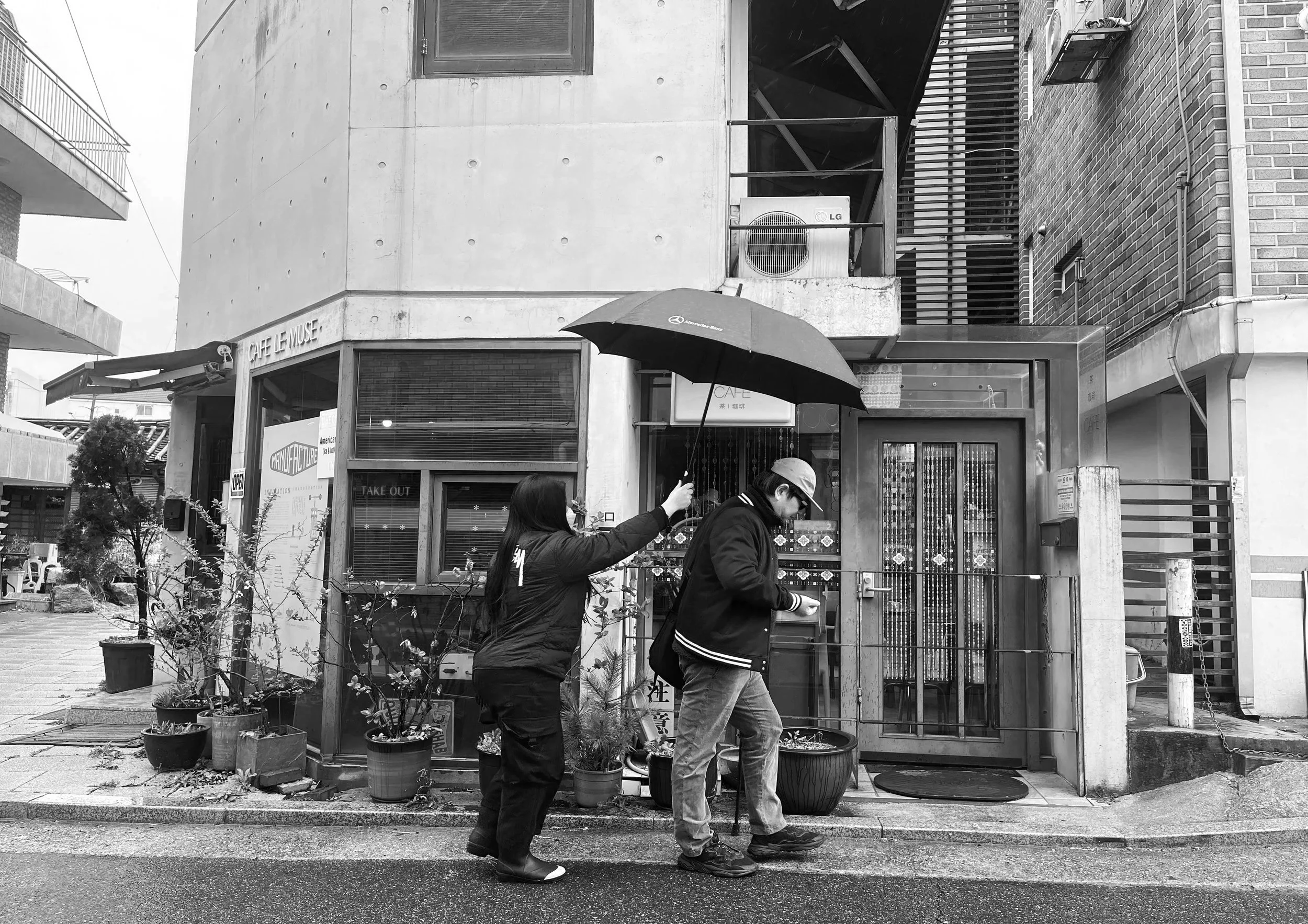
송지은 : 우비가 1+1은 1이잖아. 왜 1+1=1.5란 제목을 제안했어?
Q레이터 : 1+1은 또 다시 1이 될 것이냐, 아니면 2가 될 것이냐 그랬는데 뭐가 아니라는 거잖아. 그리고 2.5라는 되게 그 늙은 어떤 입장
송지은 : 우리가 비가 오면 외출하기 힘들잖아. 왜냐하면 Q레이터는 한 손으로 지팡이를 짚어야 하고, 한 손으로 지팡이 짚으면 우산을 들 수 없지. 나는 Q레이터한테 우산을 씌어주게 되니까 비를 맞게 되고, 그게 이 작업의 시작점이 아닐까 싶어.
송지은 : 그러니까 둘의 경험이 둘에 비 오는 날 보행하기 어려운 그러니까 밖을 걷는 것 자체가 되게 어렵잖아.
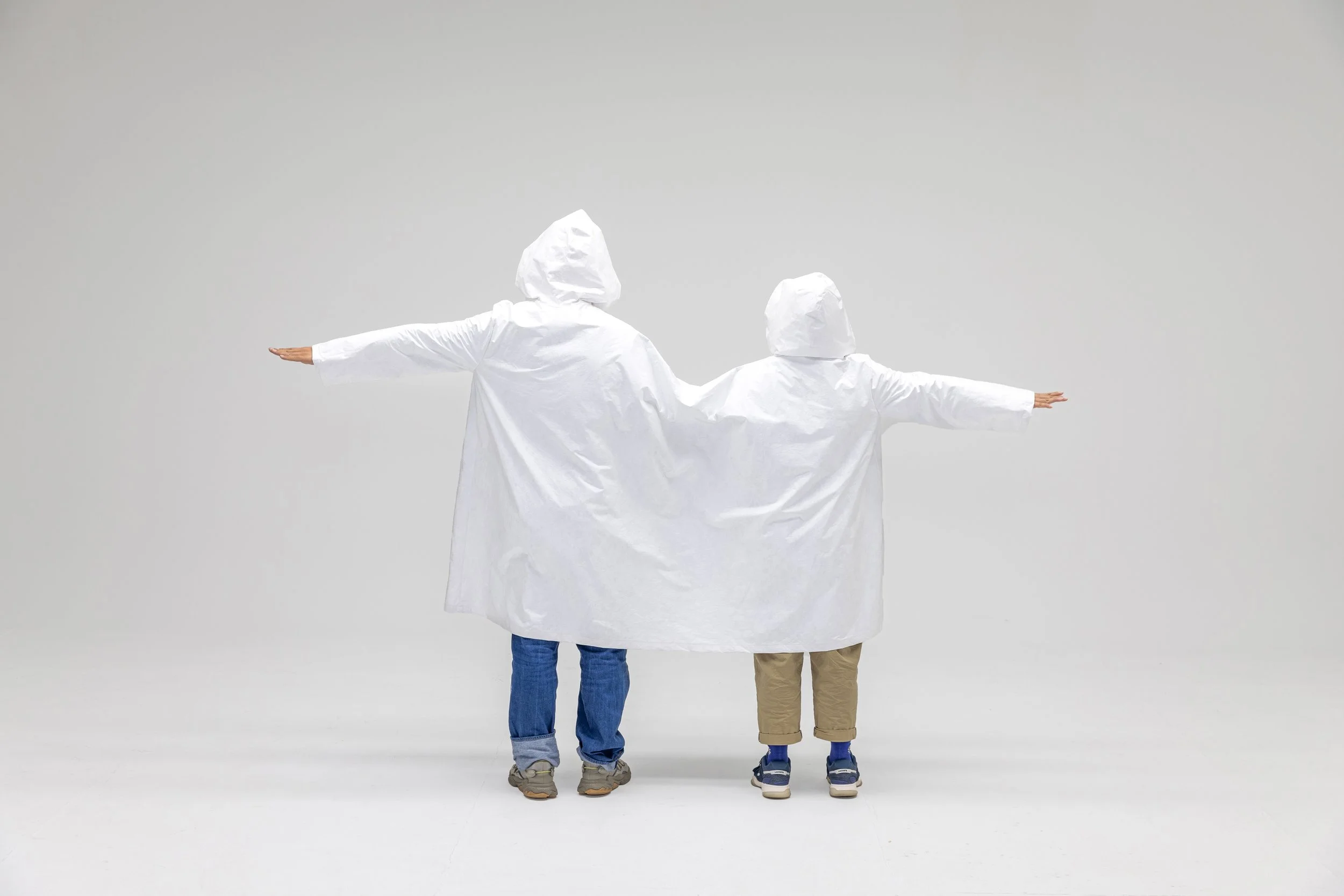
Jee Song : This raincoat is based on the idea that ‘1 + 1 = 1.’ So why did you suggest the title ‘1 + 1 = 1.5’?
Qrator : Will 1 plus 1 become 1 again, or 2? That was the question, but it turns out to be neither. This 2.5 position is a very old, worn-out one…
Jee Song : Going out in the rain is tough for us. The Q-rator has to use one hand for the cane, which means they can’t hold an umbrella at the same time. I end up holding the umbrella over them, so I get soaked. I think that might be where this work began.
Jee Song : For the two of us, walking on rainy days is difficult. Just going outside is really challenging.
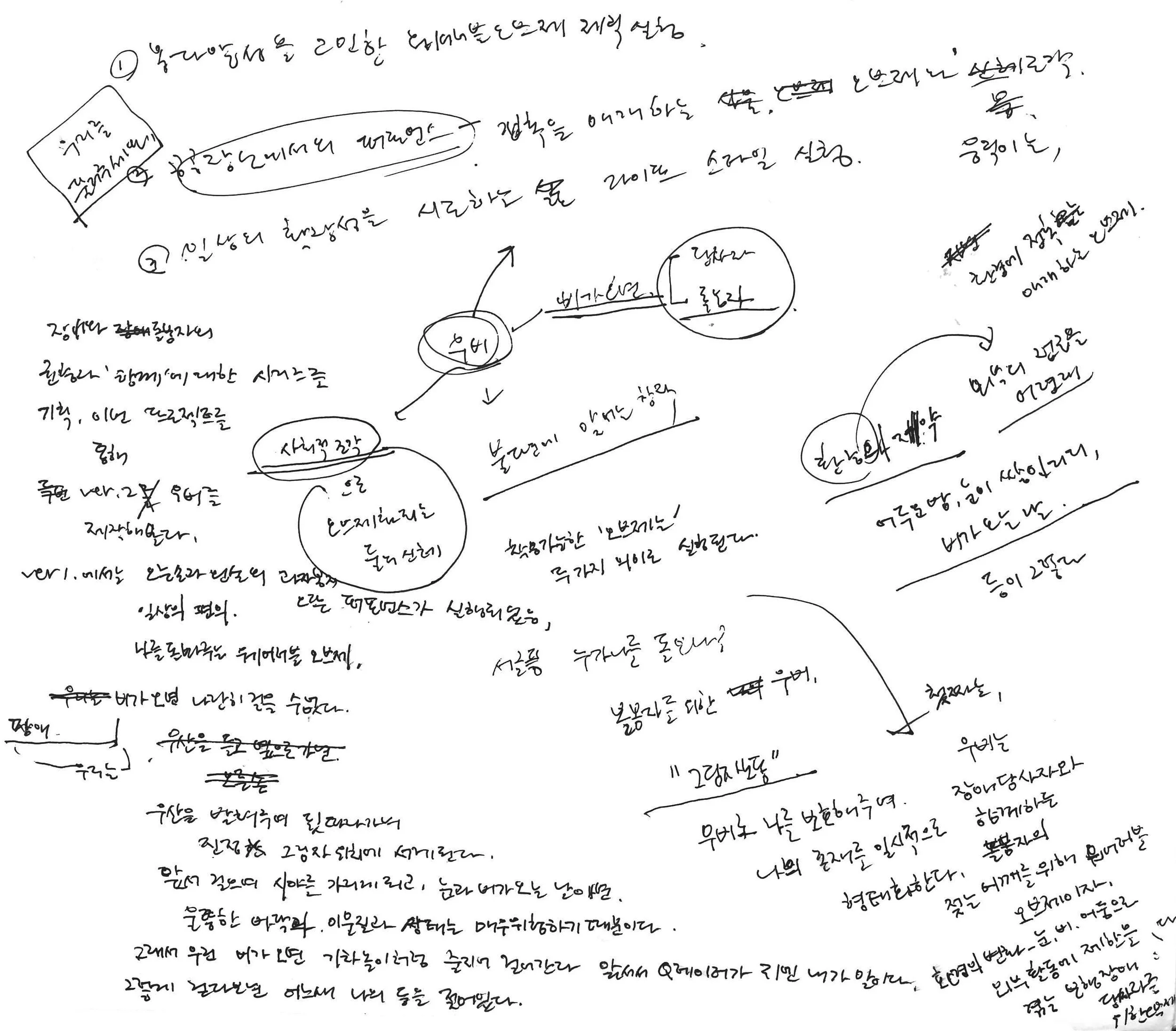
라움콘 《1+1=1.5》 2023, 텍스트, Pen on paperlaumkon 《1+1=1.5》 2023, Text, Pen on paper, Varible size.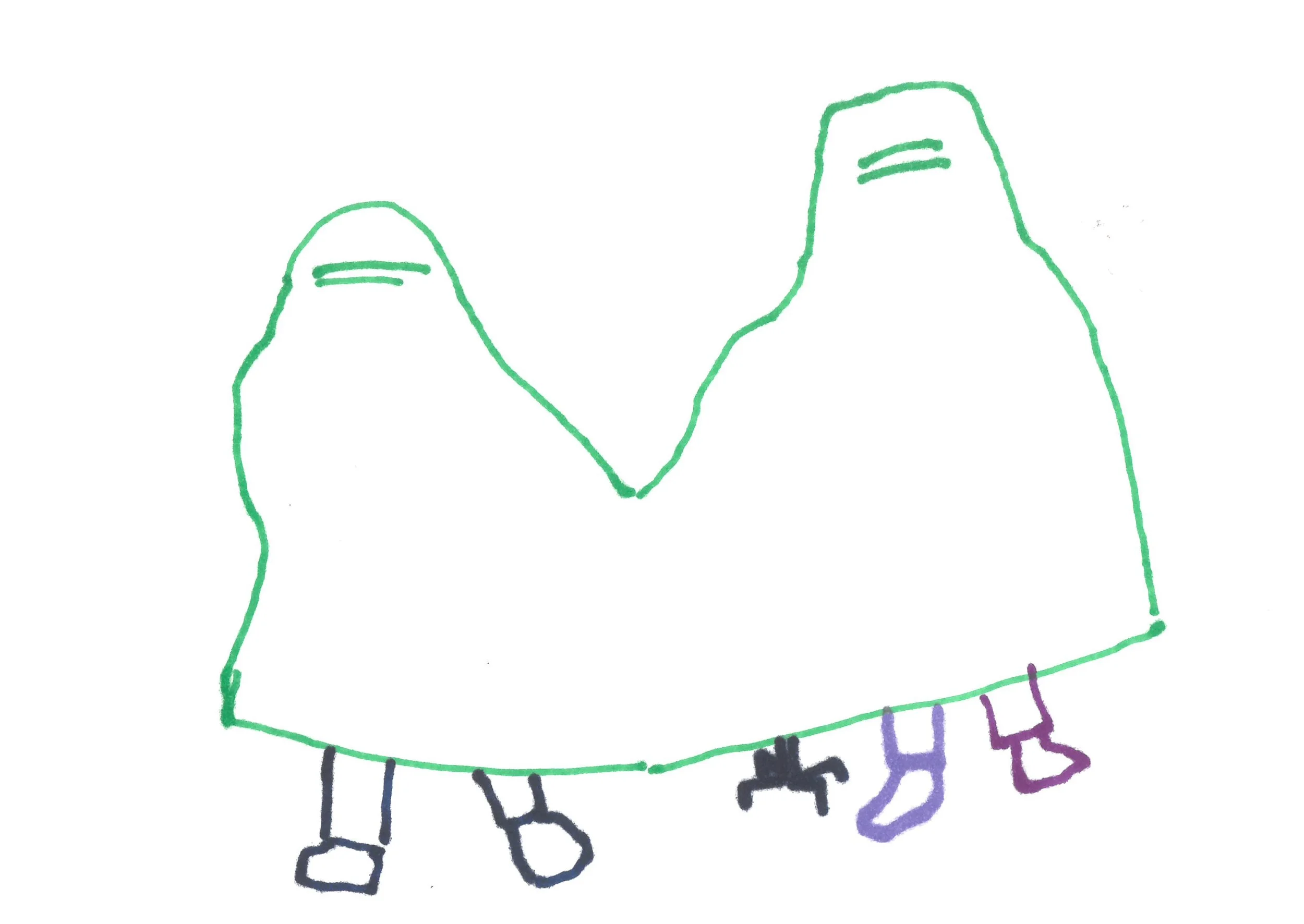
라움콘 《1+1=1.5》 2023, 드로잉, Pen on paperlaumkon 《1+1=1.5》 2023, Drawing, Pen on paper, Varible size.Tyvek is an irregular micro‑fiber sheet made by compressing high‑density polyethylene (HDPE) fibers under high pressure and heat, forming a non‑woven structure in which fine plastic fibers tangle together rather than being woven strand by strand like traditional fabric.
Because the individual fibers are extremely thin, Tyvek looks like paper from a distance, yet being plastic, it does not tear easily and does not get wet; its feel is closer to a mixture of paper, fabric, and vinyl. When crumpled by hand, Tyvek makes a crisp rustling sound; its surface is matte with a slight sense of texture, so it is neither moist nor slippery like typical plastics, and while it folds flexibly under finger pressure, it does not readily rip even when pulled with force.
Thanks to its HDPE fiber structure, the material has excellent resistance to water, air, and fine particles, is lighter than paper with superior strength‑to‑weight ratio, and is resistant to moisture and mold. Tyvek can be printed on like paper and is recyclable, which is why it commonly appears as waterproof mailing envelopes, vapor‑ and water‑barrier house wrap on construction sites, disposable protective suits in hospitals, fashion items, print media, and water‑resistant file folders for document storage.
However, it is vulnerable to heat and friction, has limited breathability, and while the surface does not tear easily, Repeated folding creates white creases, which make the surface look worn quickly and limit the ways it can be sewn.
타이백 Tyvek 은 고밀도 폴리에틸 HDPE, High-Density Polyethylene 섬유를 높은 압력과 열로 압착해 만든 불규칙 미세섬유 시트로 한 올 한 올 짠 직물이 아닌, 미세한 플라스틱 섬유들이 엉키며 만들어낸 비직조 Non-woven 구조를 띄고 있다.
섬유의 굵기 자체가 굉장히 가늘어 멀리서 보면 종이처럼 보이지만, 실제로는 플라스틱이기 때문에 찢어지지 않고, 물에도 젖지 않는다는 타이백의 촉감은 종이와 섬유 그리고 비닐을 섞어놓은 느낌에 가깝다. 손으로 구기면 사각사각한 소리가 나고, 표면은 매트한데 약간 조직감이 느껴진다. 때문에 촉촉하지도, 플라스틱처럼 미끄럽지도 않고 손가락으로 눌러보면 유연하게 접히지만, 힘을 주어 잡아당겨도 잘 찢어지지 않는다.
이 재료는 HDPE 섬유 구조 덕분에 물·공기·미세입자 차단 능력이 뛰어나고 종이보다도 가벼운데 무게 대비 강도가 우수하고 습기와 곰팡이에 강하다. 종이 같이 위에 인쇄가 가능하며 재활용도 된다. 이러한 특성은 일상에서 우편용 방수봉투, 건축 현장의 방습·방수·하우스랩, 병원에서 사용하는 일회용 방호복, 패션 제품, 프린트 소재 및 서류·문서 보관용 내수성 파일 등으로 볼 수 있다.
다만, 타이백은 열과 마찰에 약하고, 통기성의 한계가 있으며 표면 쉽게 찢어지진 않지만, 반복적으로 접었다 펴면 하얀 주름이 생기며 외관이 빠르게 마모되고 재봉 방식이 제한적이다.
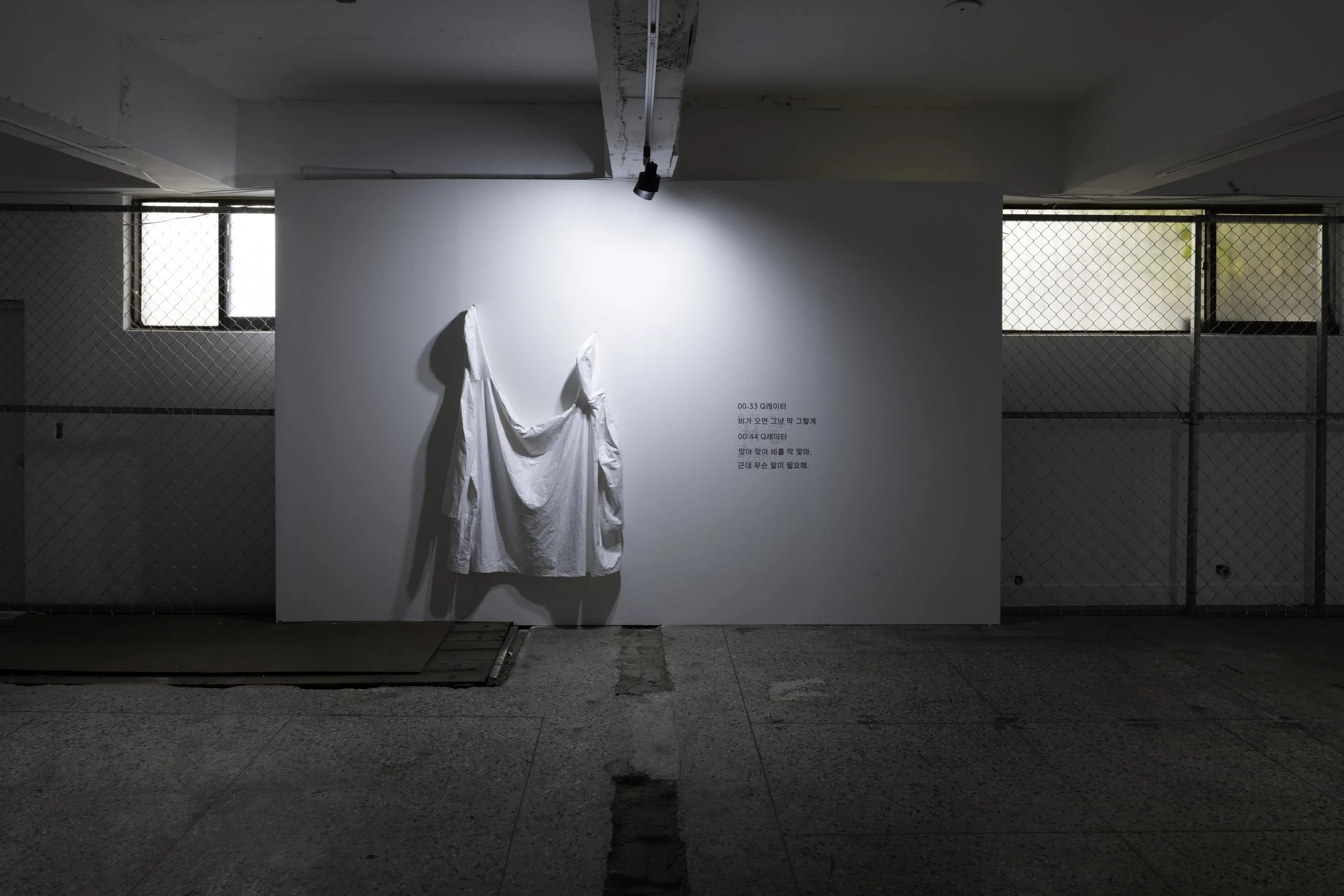
라움콘 《다시 걷는 노-하우》 2025, 전시 전경

laumkon 《Know-How of RE-walk》 2025, Installation view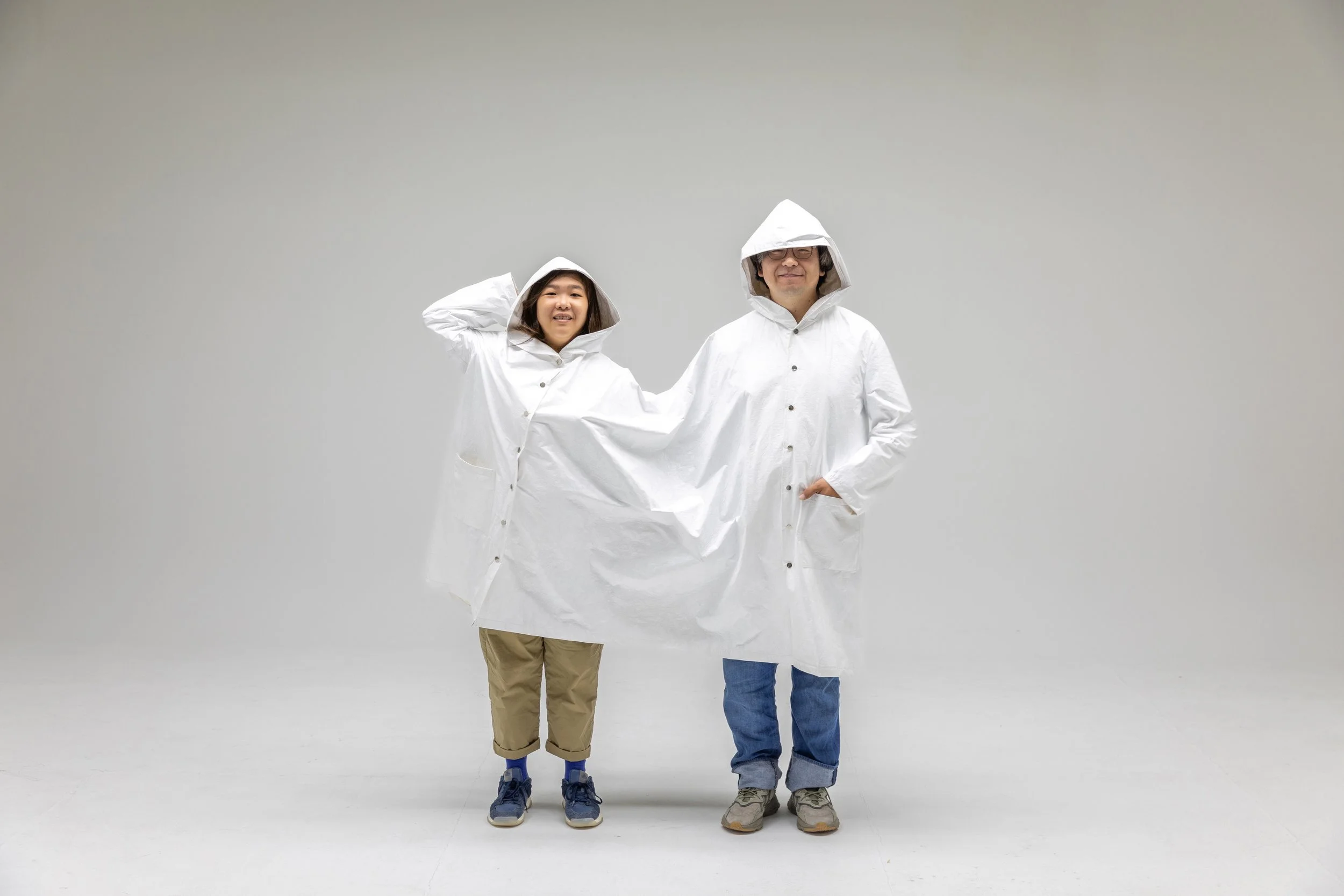
라움콘 《1+1=1.5》 2023, 흰 색 타이백천, 은색 스냅단추, 가변사이즈laumkon 《1+1=1.5》 2023, White tyvek, Silver snap, Varible size. 라움콘 《1+1=1.5》 2025, 5분laumkon 《1+1=1.5》 2025, 5mins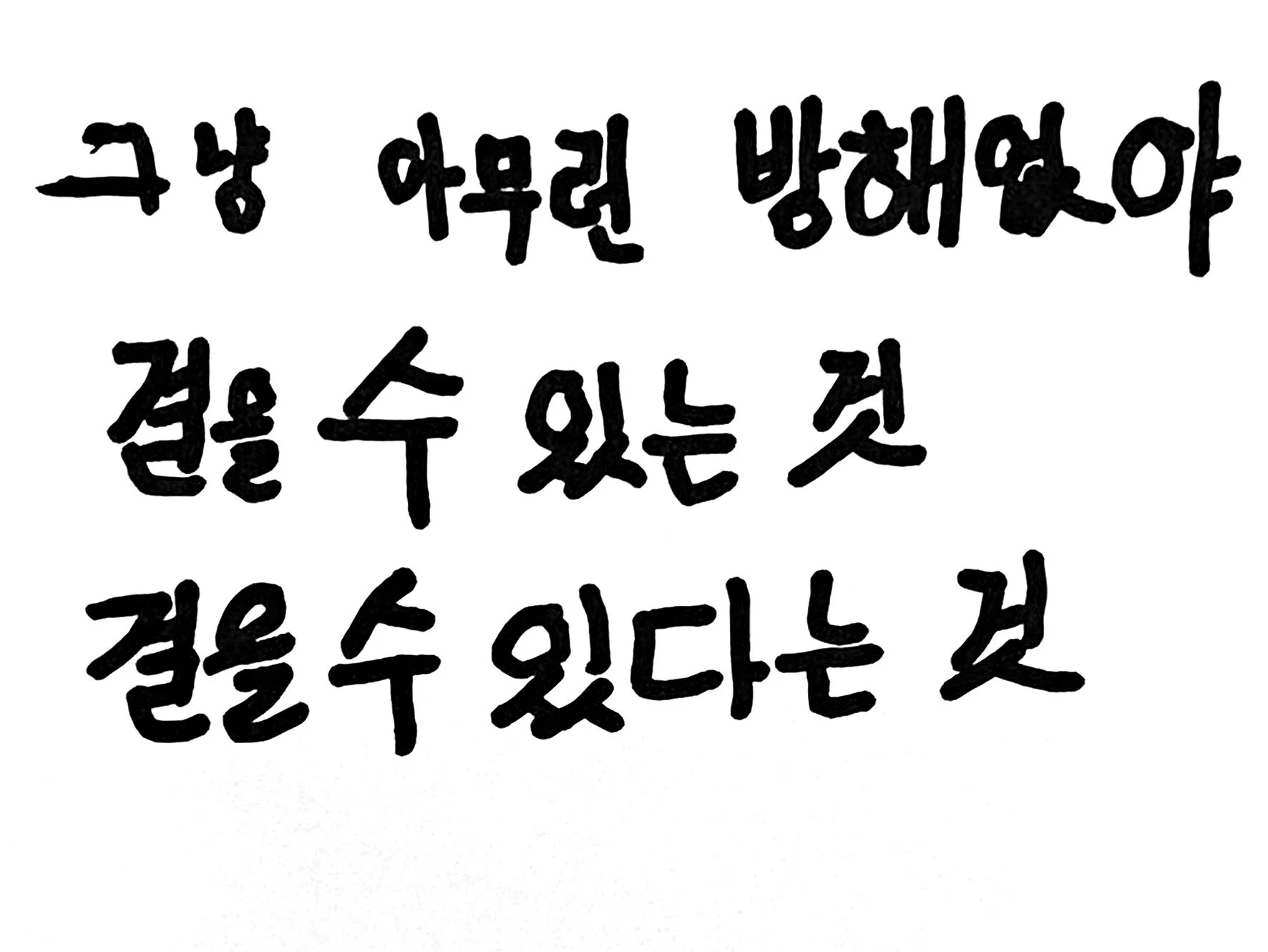
라움콘 《다시 걷는 노-하우》 2019, 텍스트, Pen on paper

laumkon 《Know-How of RE-walk》 2019, Text, Pen on paper, Varible size.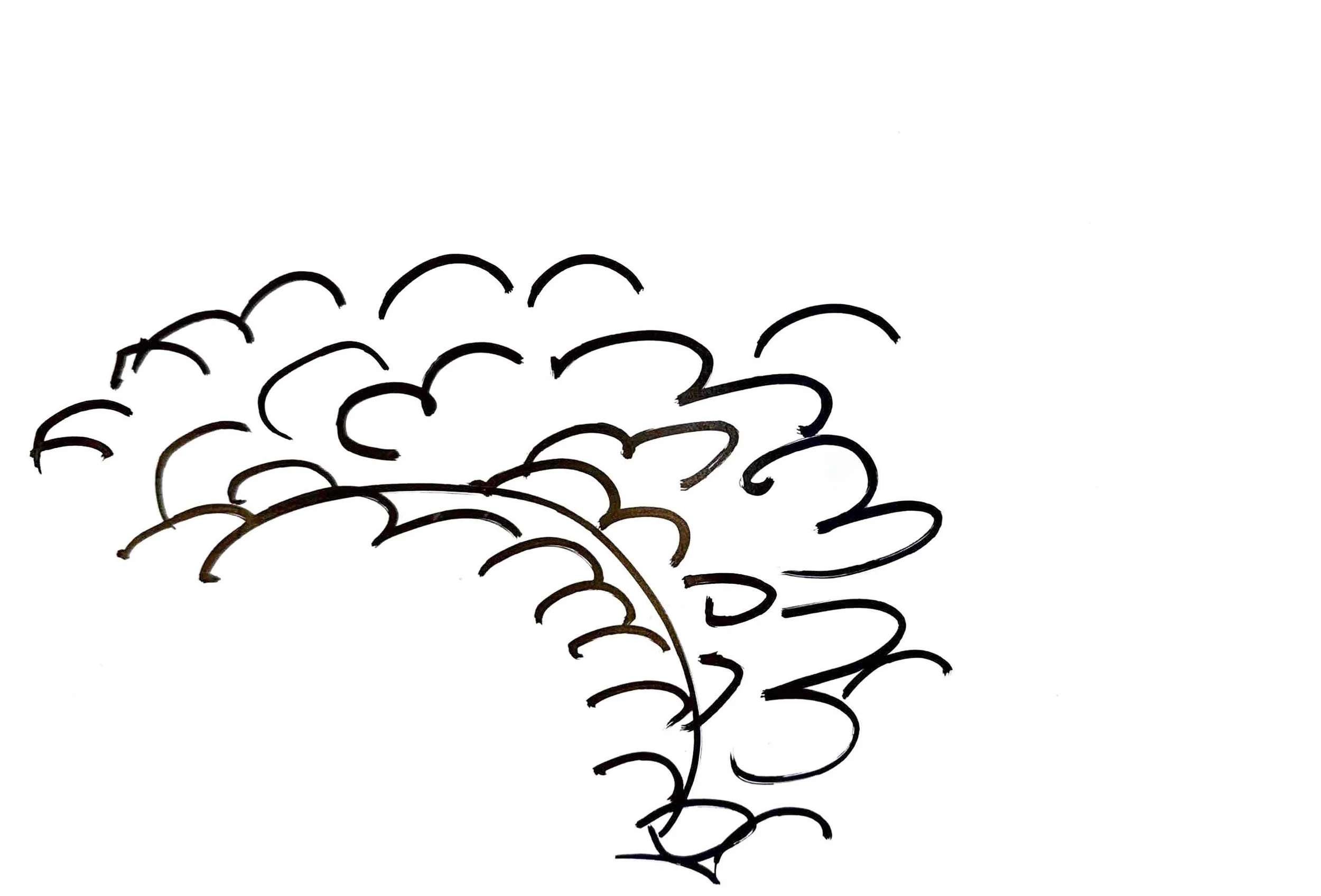
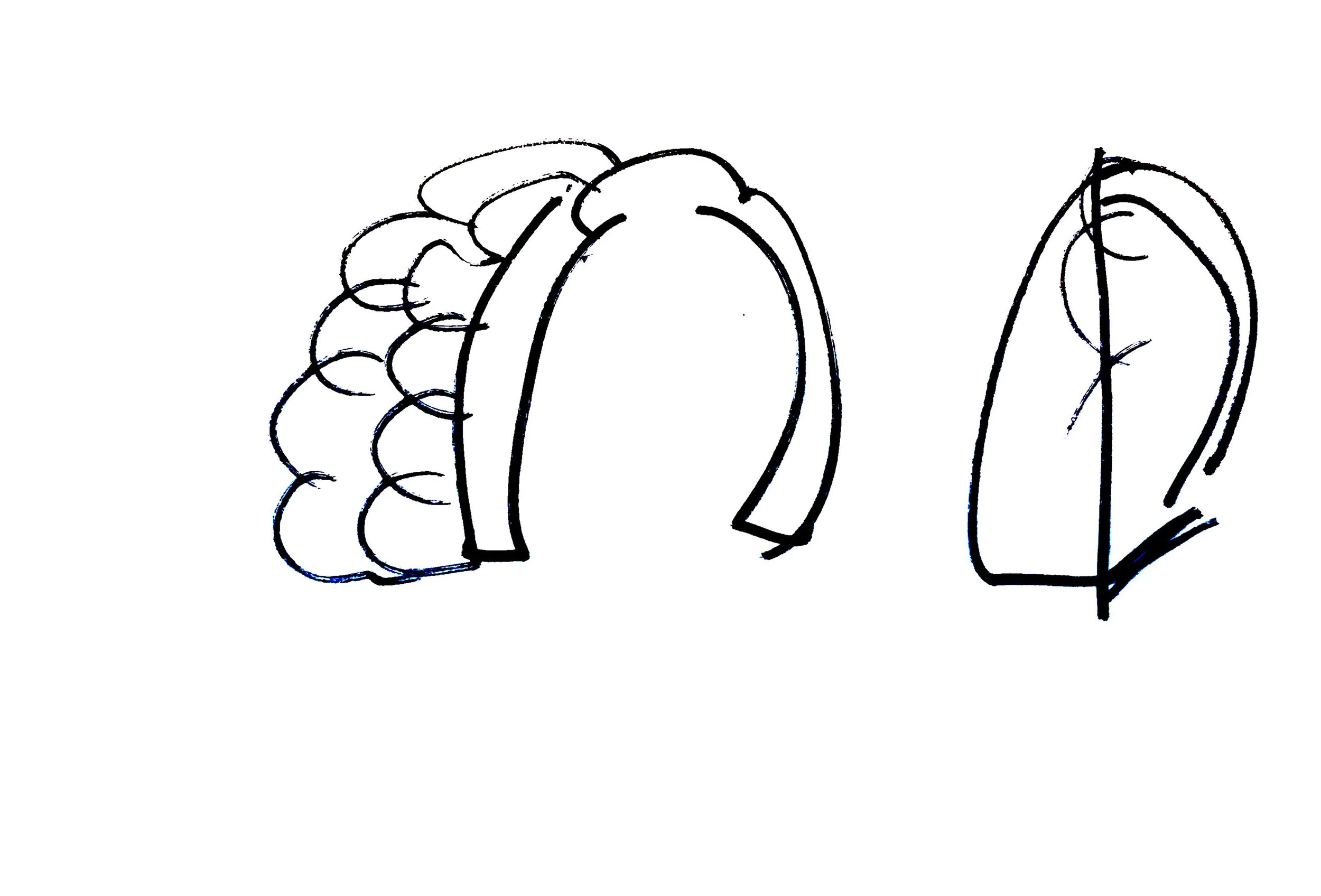
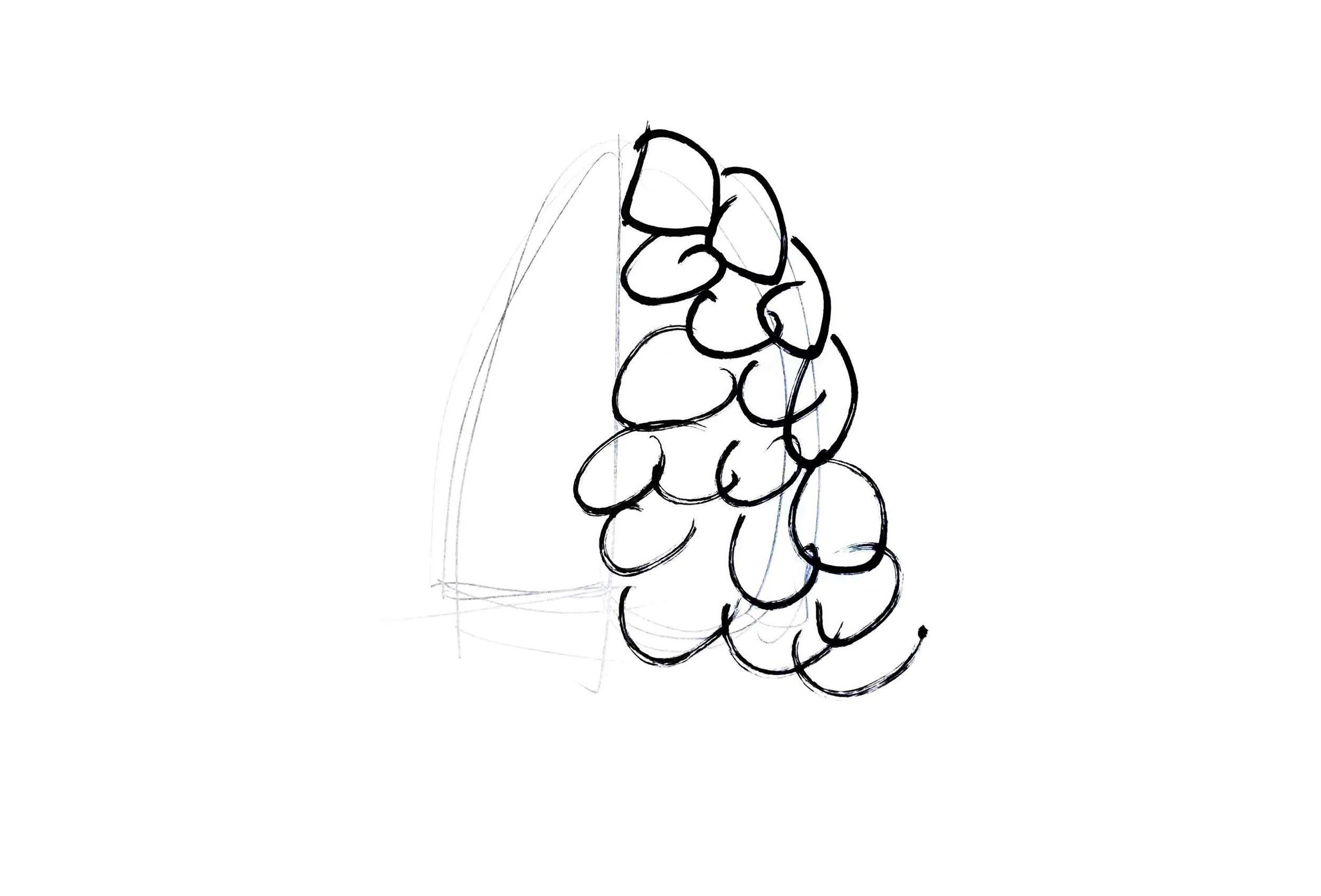
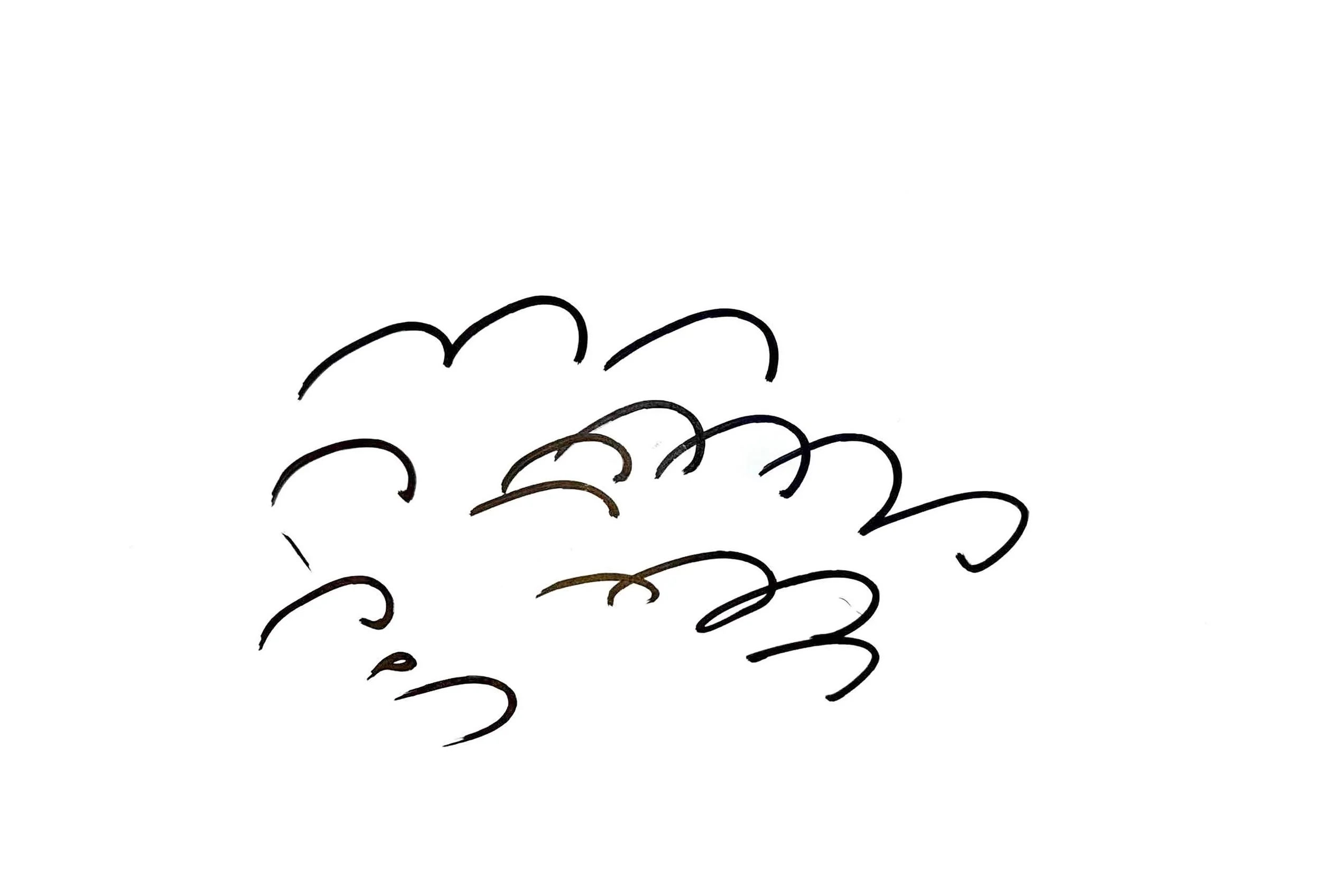
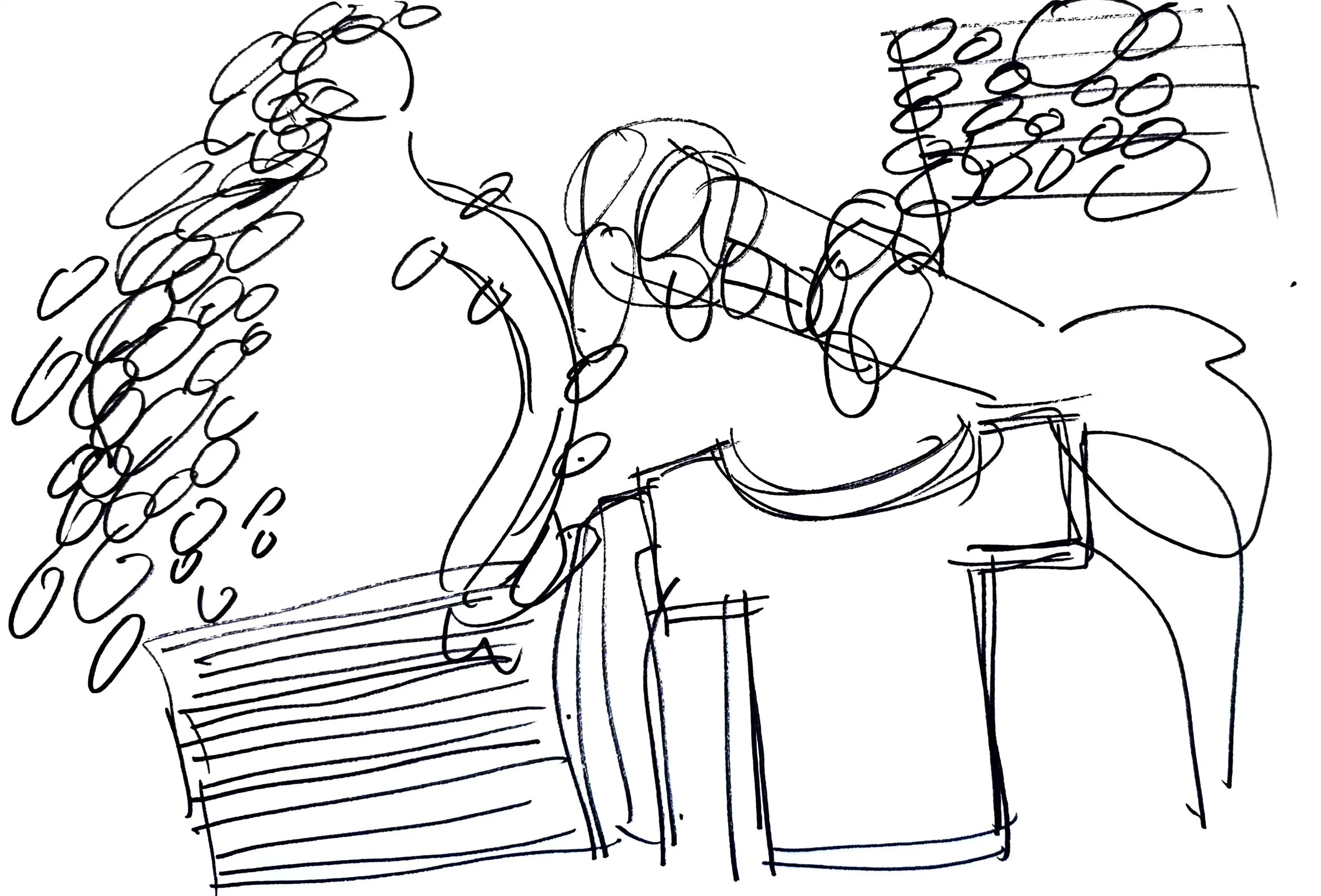
라움콘 《나이트 시그널》 2025, 드로잉, Pen on paper

laumkon 《Night signal》 2025, Drawing, Pen on paper, Varible size.
재귀반사천은 빛을 원래 온 방향으로 되돌려 보내는 특수한 직물이다. 보기에는 평범한 회색천 같이 보이지만 표면 구조가 매우 미세하고 질서 있게 배열된 기술적 직물로 유리비드 glass beads 또는 마이크로 프리즘 Micro-prism이 표면에 촘촘하게 박혀 있어 빛을 반사한다.
재귀반사천은 유리비드형과 프리즘형이 있다. 유리비드형은 매우 작은 구형 유리(실리카 기반 미세구슬)가 표면에 분산되어 있으며 각각의 구슬이 렌즈 역할을 하며 빛을 입사 방향으로 되돌린다. 프리즘형은 미세한 삼각 프리즘 구조가 플라스틱 필름(PVC, TPU, 아크릴 등) 위에 정교하게 찍혀 있어 반사 기능이 뛰어나고 유리비드형 보다 반사되는 빛이 날카롭다.
이 재료는 손으로 만지면 약간 거칠고 미세하게 사포 같은 느낌이 있데, 유리비드형은 특히 그렇다. 프리즘형은 표면이 매끈하지만 딱딱한 필름처럼 느껴지고, 약간 플라스틱 같아서 유리비드형과 다르지만, 두 종류 모두 두께감이 있어 구김이 잘 안 생기거나 한 번 생기면 오래 남는 경우가 많다.
빛을 받지 않으면 무광 회색천으로 보여지만 빛이 닿는 순간 반사 빛을 반사하는 특수한 느낌을 주기 때문에 재귀반사천은 야간 조깅복, 운동복, 아우터에 붙는 반사띠, 자전거, 오토바이, 전동 킥보드용 안전 조끼 교통경찰·소방·구급대의 유니폼, 등산용 가방·텐트·로프, 교통 표지판, 어린이 가방, 유모차의 반사 패치 그리고 산업 현장의 작업복·안전 장비에 사용된다.
하지만 표면이 긁히거나 마찰을 반복하면 유리비드형은 쉽게 표면이 벗겨지고, 프리즘형은 스크래치가 생기며 광학 구조가 망가져 반사력이 급격히 떨어진다. 또한 보통의 직물과 달리 유연성이 낮아 플라스틱 필름처럼 뻣뻣한 느낌을 주며 몸을 따라 흐르지 않기 때문에 착용형 오브제로 만들면 움직임이 다소 기계적이다. 바늘땀이 너무 촘촘하면 코팅층이 갈라지고, 열 재단은 코팅을 녹여버리는데 프리즘형은 단면도 깨끗하게 잘리지 않아 제작 시간이 더 소요된다.
Retroreflective fabric is a specialized textile that returns incoming light back in the direction it came from. To the eye it may look like an ordinary gray cloth, but it is in fact a highly engineered material whose surface is microscopically structured in an orderly way, densely embedded with glass beads or micro-prisms that reflect light.
There are two main types: glass-bead and prism types. In the glass-bead type, very small spherical glass (silica-based microbeads) are dispersed over the surface, each bead acting as a tiny lens that sends light back toward the direction of incidence. In the prism type, fine triangular prism structures are precisely embossed onto a plastic film (PVC, TPU, acrylic, etc.), providing excellent reflectivity and a sharper return of light than the bead type.
To the touch, retroreflective fabric feels slightly rough, with a faint sandpaper-like texture—especially in the glass-bead type. The prism type has a smoother surface but feels like a stiff plastic film, somewhat different from the bead type; both, however, tend to have a certain thickness, so they do not wrinkle easily, or once creased, the folds often remain for a long time.
When not illuminated, it appears as a matte gray fabric, but the moment light strikes it, the material sends back a striking reflection, which is why it is used in night-running gear, sportswear, reflective strips on outerwear, safety vests for cyclists, motorcyclists, and e-scooter riders, as well as uniforms for traffic police, firefighters, and paramedics, and on hiking backpacks, tents, and ropes, road signs, children’s bags, strollers, and workwear and safety equipment in industrial settings.
However, when the surface is scratched or subjected to repeated friction, the glass-bead type easily sheds its surface layer, while the prism type develops scratches that damage the optical structure, causing reflective performance to drop sharply. Unlike ordinary textiles, it has low flexibility and feels stiff like plastic film, so it does not drape naturally with the body, making movement somewhat mechanical when used as a wearable object; if the stitching is too dense, the coated layer can crack, and heat-cutting can melt the coating, while the prism type in particular does not cut with clean edges, increasing production time.
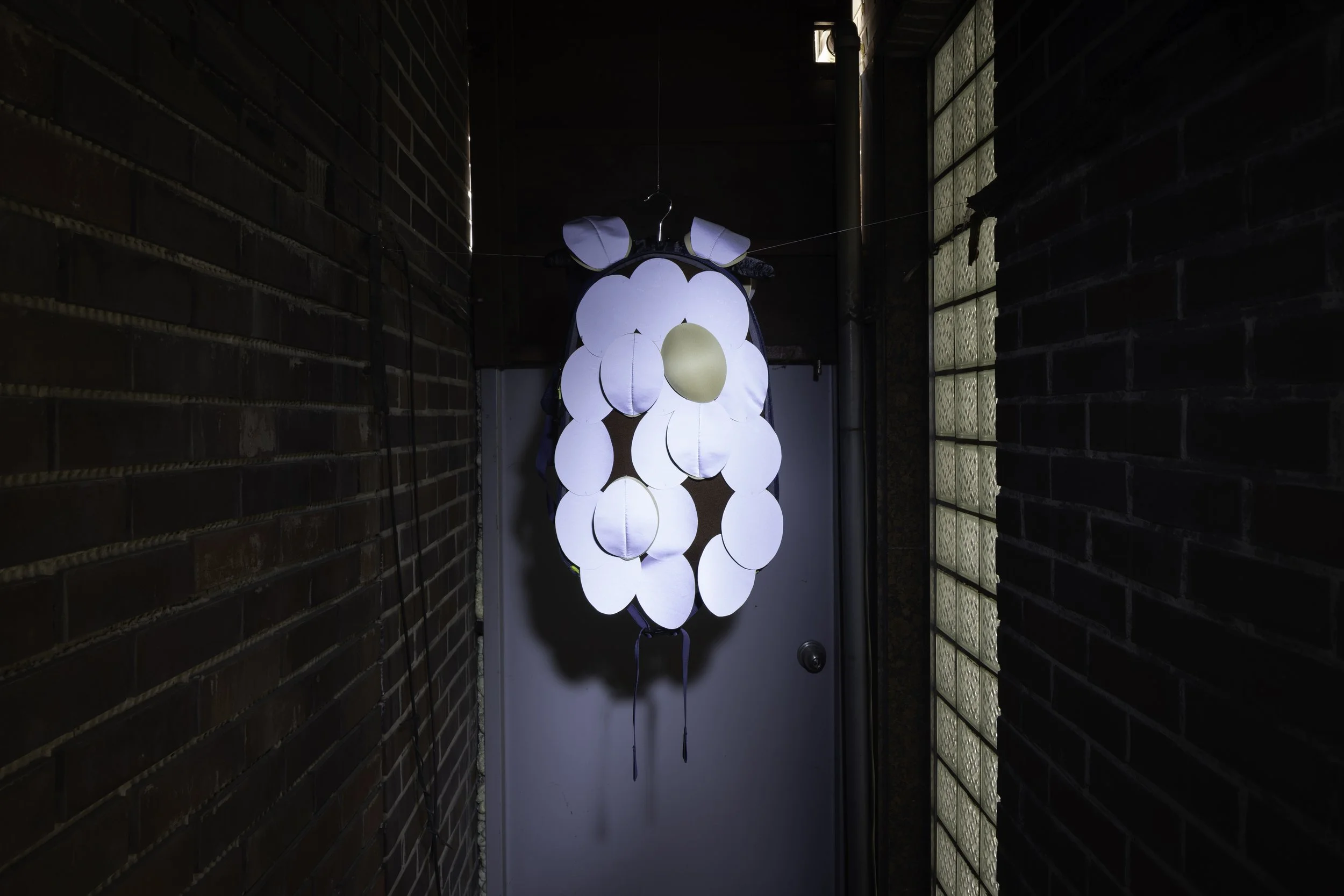
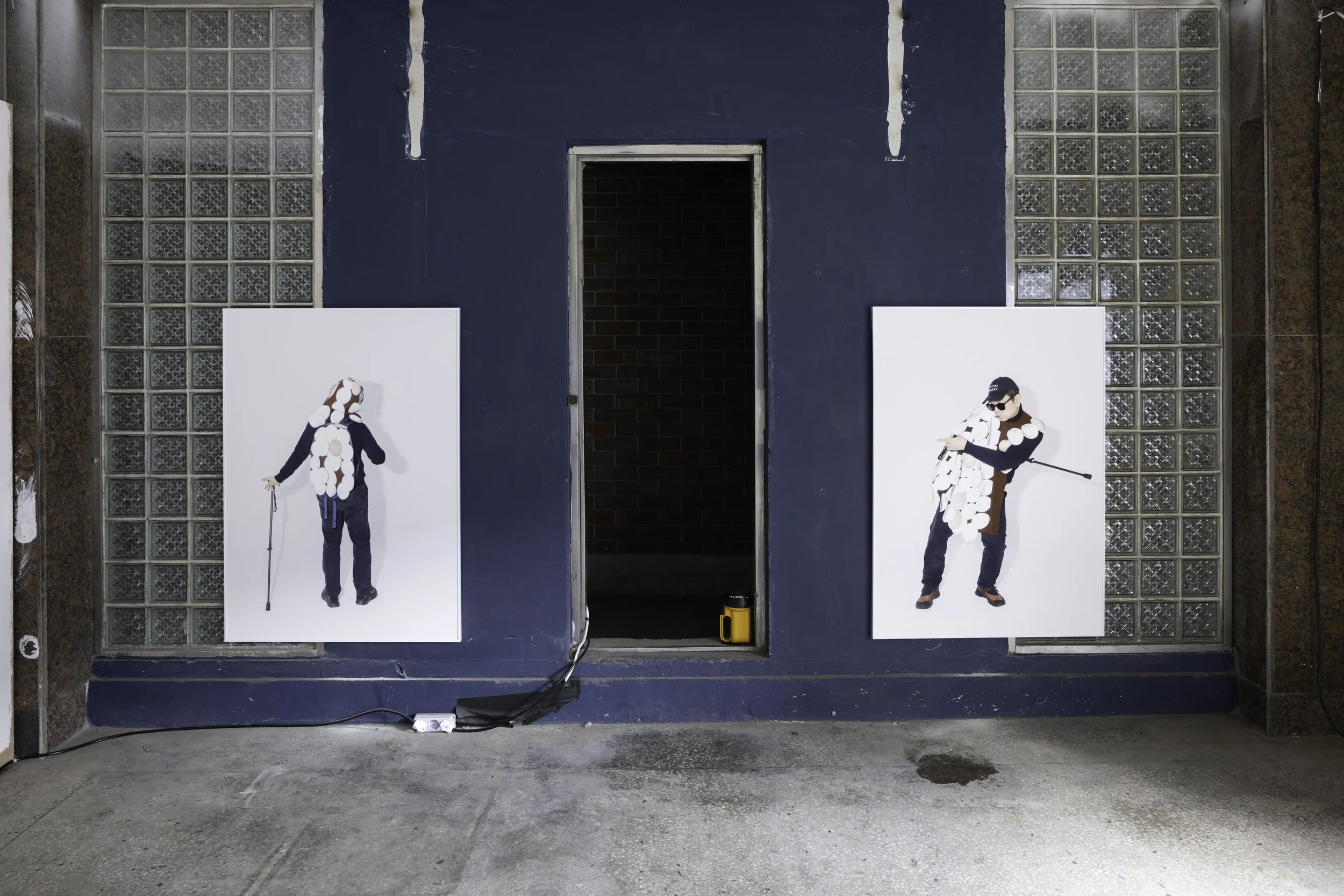
라움콘 《다시 걷는 노-하우》 2025, 전시 전경

laumkon 《Know-How of RE-walk》 2025, Installation view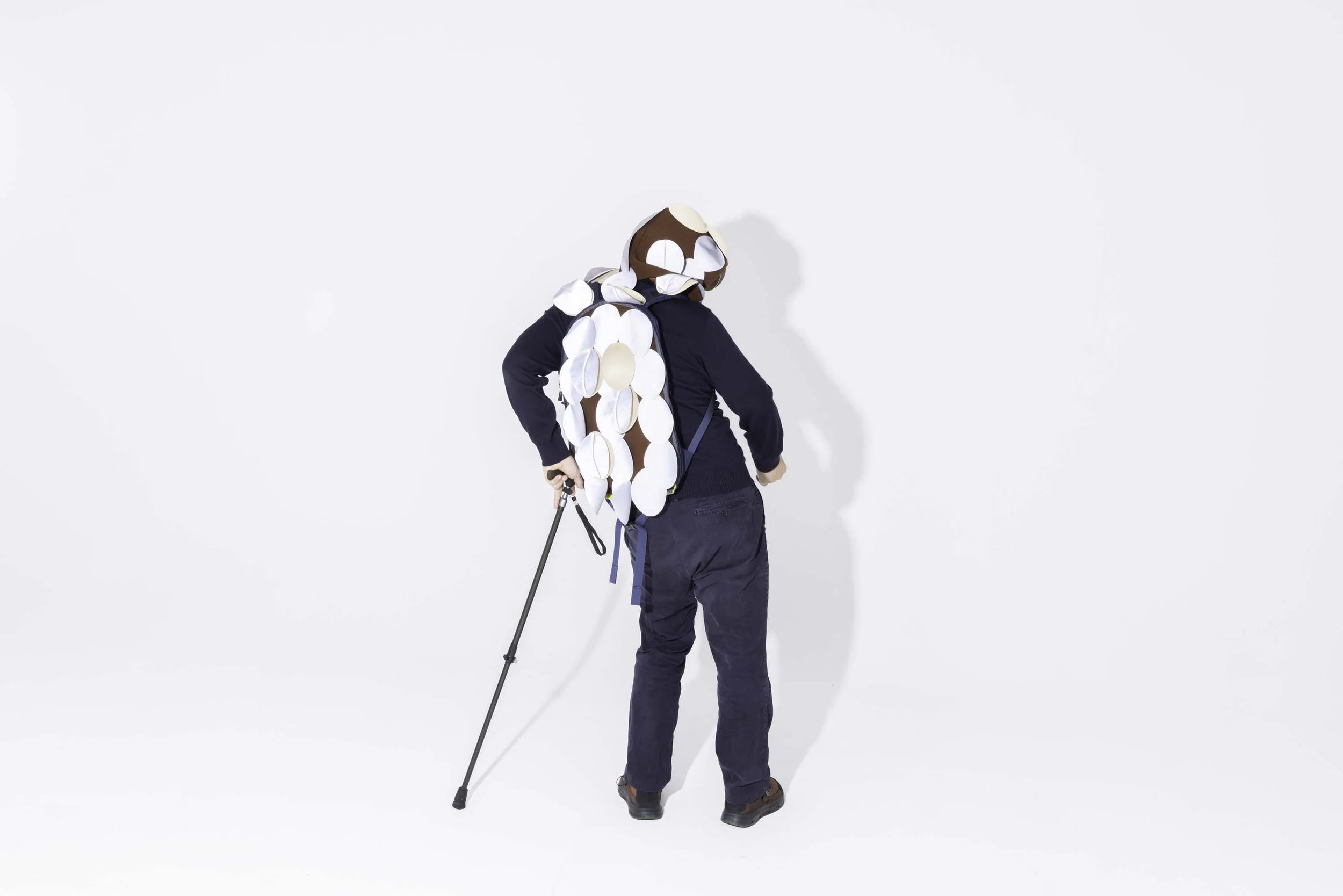
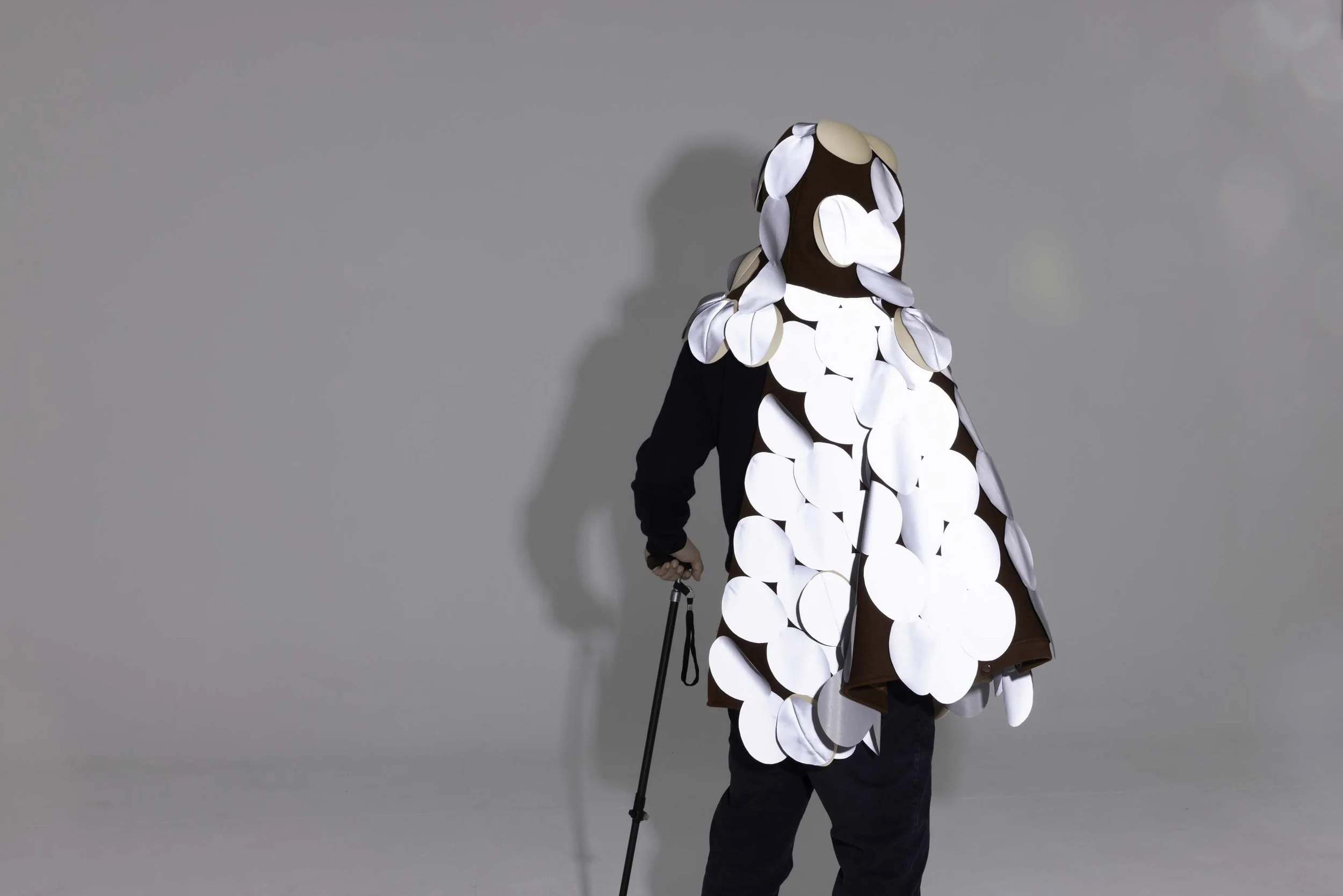
라움콘 《나이트 시그널》 2025, 재귀반사천, 여성 속옷 몰드, 가방, 망토, 실, 가변사이즈laumkon 《Night signal》 2025, Retroreflective fabric, Molded Cup, Rucksack, Cloak, Variable size.라움콘 《나이트 시그널》 2025, 5분 laumkon 《Night signal》 2025, 5mins다시걷는 노-하우, 라움콘
2018년 10월 7일 갑작스럽게 발생한 뇌출혈 후유증으로 오른편 마비를 갖게 된 라움콘 Q레이터와 송지은은 *재활 Rehabilitation 을 끝내면 어디든지 자유롭게 이동 가능할 것이라 생각했다. 대부분의 재활 과정은 걷기 위주로 진행되었고 누워서 병원에 입원했지만 걸어서 집으로 갔다,는 누군가의 이야기는 전설처럼 남겨졌기 때문이다. 하지만 우린 도시의 인도가 얼마나 다양하고 높낮이와 기울기가 있는지 몰랐고 비가 오거나 눈이 오는 날 한 손으로 지팡이를 사용하기 때문에 우산을 쓸 수 없음을 알지 못했으며 밤이 되어 잘 보이지 않는 환경 때문에 밤 외출이 불가능한지 상상하지 못했다. 기능 위주의 재활에서 알지 못했던 일상을 다시걷는 경험은 우리에게 예전과 다른 몸으로 다양한 환경에서 어떻게 하면 다시금 자유롭게 걸을 수 있을지 고민하게 하였다.
우리는 일상의 다양한 장소를 방문하며 걷는 과정을 영상으로 기록하였고 불안전한 경험을 감각하였다. 불안전하고 위험한 경험은 스스로를 안전하게 보호할 수 있는 방식을 모색하게 하였고 울퉁불퉁한 거리를 걷는 경험은 일상에서 흔히 볼 수있는 에어캡을 활용하여 신체를 보호해 보는 방식으로 날씨에 따라서 외출이 힘들었던 둘의 경험은 함께 착용가능한 우비 형태로 확장 되었으며 어두운 밤, 도로의 번잡함과 차량 진입으로 느린 속도의 걷기가 이동에 참여할 수 없었던 기억의 대화는 드로잉으로 이어지며 웨어러블 오브제 제작 방식을 구체화시켰다.
《다시걷는 노-하우》(2019-2025)는 다양한 환경에서 걷기 위해 웨어러블 오브제를 제작해보는 프로젝트로 《Move by 라움콘》(2019), 《1+1=1.5》(2023) 그리고 《나이트 시그널 Night signal》(2025)로 구성되었다. 투명한 PVC 비닐로 제작된 《Move by 라움콘》 (2019)은 바람을 불어넣으면 팽팽해지며 높이 2미터 가량의 크기로 확장된다. 걷기 방식에 따라서 움직이는 관절 부위를 관찰한 후, 발목, 종아리와 허벅지, 팔뚝과 팔 그리고 팔목, 머리, 몸통으로 나누어 제작하였으며 각 신체 부위를 감싸는 방식으로 착용하고 하얀 스냅 단추로 고정할 수 있게 고안되었다. 흰색 타이백천과 은색 스냅단추를 사용하여 제작된 《1+1=1.5》(2023)는 두 신체가 함께 착용 가능한 우비다. 지팡이를 사용하는 Q레이터의 왼손과 송지은의 오른손은 자유롭게 움직일 수 있게 제작하였고, 비가 와서 불안전한 미끄러운 길을 이동할 때의 위험한 순간을 대비하여 Q레이터의 오른쪽 신체와 송지은의 왼쪽 신체는 우비 안 공간에서 접촉이 가능하게 제작되었다. 《나이트 시그널 Night signal》(2025)는 어두운 장소에서 착용하는 모듈 형태의 오브제다. 이 모듈은 주변의 빛을 흡수하여 반사시키는 재귀반사 천과 여성 속옷에 사용되는 몰드컵을 재료로 사용하였다. 부착된 부위에 주변 빛을 흡수, 반사기키며 어두운 곳에서 신체를 잘 보이게 하는 《나이트 시그널 Night signal》은 거추장스러운 전신 커버 형태를 지양하고 어디서든 쉽게 부착 가능한, 모듈 형식을 빌려 제작하였다. 동그란 형태의 모듈을 다양한 곳에 부착이 가능한데 우린 배낭의 등 부위를 절개하여 가방의 수납 기능대신 모듈을 부착하였고, 상체를 덮는 망토와 모자 일부에 패턴처럼 모듈을 부착, 외출복과 기능을 연결해 보았다.
신체에 착용하고 다양한 환경에서 걷기를 시도하는 과정은 일종의 퍼포먼스이자 견고한 환경 속에서 다양한 형태의 삶이 살아갈 방식을 찾아보는 실천이자 실험이다. 각각의 웨어러블 오브제는 몸과 환경 사이 이질감을 주목하며 우리가 살아가는 일상 공간을 어떻게 접촉할 수 있는지 탐구하는 《다시 걷는 노-하우》는 '걷기'라는 행위를 통해 일상의 다양한 장소, 날씨, 상황을 탐구하고 우리를 둘러싼 환경을 다른 관점에서 바라보기를 제안하며 다양한 몸이 어떻게 환경과 연결되고 배제되는지 예술의 언어로 질문하며 비판적 관점에서 바라보기를 제시한다.
*재활 Rehabilitation 장애를 가진 사람이 가질 수 있는 최적의 기능을 성취하고 유지하거나, 삶의 질을 향상시키기 위해 이루어지는 모든 치료
Know-how of Walking Again, laumkon
After laumkon’s Qrator developed right‑side hemiplegia as a sequela of a sudden cerebral hemorrhage on October 7, 2018, he and Jee Song believed that, once rehabilitation was complete, they would be able to move freely anywhere. This was because most rehabilitation focused on walking, and the story of someone who had been hospitalized in bed but eventually walked home remained like a legend. However, they had not realized how varied urban pavements are, in terms of level and slope; they had not imagined that, on rainy or snowy days, using a cane with one hand would make it impossible to hold an umbrella; nor had they anticipated that night outings would be impossible because the environment became hard to see after dark. The experience of “walking again” in everyday life, which had not been visible within function‑oriented rehabilitation, led them to consider how, with a body now different from before, they might once again walk freely through diverse environments.
They visited various everyday locations, recording the act of walking on video, and attuned themselves to these precarious experiences. Unstable and hazardous situations prompted them to search for ways to protect themselves. The experience of walking on uneven streets led them to try using bubble wrap, a common packaging material, to protect the body; their difficulty in going out together depending on the weather was extended into a shared raincoat form that both could wear; and conversations about memories of being unable to participate in movement because of slow walking speed amidst nighttime darkness, road congestion, and car traffic developed into drawings that concretized the approach to producing wearable objects.
Know-how of Walking Again (2019–2025) is a project that produces wearable objects for walking in diverse environments, comprising Move by laumkon (2019), 1+1=1.5 (2023), and Night Signal (2025). Move by laumkon (2019), made from transparent PVC vinyl, inflates with air to become taut and expands to a height of around two meters. After observing the joints that move during walking, they divided the body into ankles, calves and thighs, forearms and arms, wrists, head, and torso, producing parts for each area, designed to be worn by wrapping around the respective body part and fastened with white snap buttons. 1+1=1.5 (2023), made with white Tyvek fabric and silver snaps, is a raincoat designed for two people to wear together. It allows the left hand of Q-rator, who uses a cane, and the right hand of Jee Song to move freely. At the same time, the right side of Q-rator’s body and the left side of Jee Song’s body can come into contact within the raincoat, providing support to prevent accidents on slippery, rain-soaked paths. Night Signal (2025) is a modular object worn in dark environments. The modules are made from retroreflective fabric that absorbs and reflects surrounding light and from molded cups normally used in women’s underwear. Absorbing and reflecting light at the points where they are attached, the Night Signal modules make the body visible in the dark; avoiding the cumbersome form of full‑body coverage, they adopt a modular format that can easily be attached anywhere. The circular modules can be attached to various places: The artists cut into the back panel of a backpack, removing its storage function and replace with modular attachments.These modules were also arranged as patterns on parts of a cape and hood that cover the upper body, creating a link between everyday clothing and functionality.
Each wearable object attends to the sense of estrangement between body and environment; Know-how of Walking Again, which explores how we can come into contact with the everyday spaces we inhabit, uses the act of “walking” to investigate different places, weathers, and situations of daily life and proposes viewing our surrounding environment from another perspective. The process of putting these objects on the body and attempting to walk through diverse environments is a kind of performance, as well as a practice and experiment in seeking ways for different forms of life to inhabit rigid surroundings. At the same time, it poses, in the language of art, questions about how different bodies are connected to and excluded from their environments, and invites a critical way of looking at these conditions.
*Rehabilitation: All forms of treatment aimed at enabling a person with a disability to achieve and maintain the best possible level of functioning, or to improve their quality of life